Unesco World Heritage site: Al Ain Oasis

One of the UNESCO World Heritage Sites in the UAE is the Al Ain oasis located in the center of Al Ain adjacent to the Al Ain museum and the Eastern Fort.

On all of our visits we have parked close to the Western Gate area and entered from there. At this entrance you will be welcomed by a guide handing you one of the above maps. It is a very pleasant walk from the Western Gate to the Al Ain museum and the Eastern fort on the opposite site of the oasis. One walks below lush, green date palm trees which provide shade for the visitor and shorter trees e.g. citrus, papaya and bananas.

The date palm produces female and male plants with only the female producing the delicious dates which are ready for harvest between July and August. Since palm trees need a fair amount of water to thrive a controlled watering system which allocates just enough at pre-determined times is used in the oasis: the thousands of years old Falaj (or aflaj (pl)). The falaj watering system of this oasis with its canals and gates to guide the water towards the desired area of irrigation has been restored and can be viewed in action while walking around. Each parcel of land separated by a stone wall belongs to one family and the water distribution is decided upon democratically.

All parts of the palm tree have been used in the daily life of the oasis inhabitants and in Bedouin life. The green leaf parts can be dried and then woven into mats, bags, bowls and day to day items. The spine or entire frond was used for creating roofs and walls by binding them together with rope made from fibres of the palm trunk. The palm trunk could be used for wooden beams in forts or in thinner sticks to hold up the woven palm walls and roof for a summer house: the Areesh or Barasti.

After a stroll through the oasis the Eastern exit leads to the Al Ain museum with its exhibits of archaeological artifacts, traditional culture and gifts given to HH Sheik Zayed bin Sultan al Nahyan. It showcases the daily life of Bedouins before the oil arrived and the skills needed to survive. The oasis and surrounding areas  have been inhabited for thousands of years and some artifacts date back to 2,500 BC. All four sites: Al Ain oasis (traditional falaj system), Bida bint Saud (tombs), Jebel Hafit (ancient burial tombs dating back to 5,000 BC) abd Al Hili (Bronze and iron age sites and tombs) – have been named the Al Ain UNESCO Archaeological Sites.

On our way back to the parking lot we like to take a left turn outside of the Western Gate and have a short stroll through the small, botanical garden with its local trees and plants all with name tags for easy identification to reach the Ecological centre.

Interactive screens explain the parts and uses of the date palm tree and the different archaeological sites with their importance in the history of settlement in this area. It has been built with sustainable materials and its roof decorative design resembles the light falling through a palm tree canopy. With air-conditioning this is a pleasant place to explore during anytime of the year.

Before leaving I like to take a look at the gift shop with its handwoven palm-frond handbags, printed coffee mugs and books about the history of the UAE. A snack or meal in the adjacent cafe serving local dishes is highly recommended. One doesn’t want to drive back to the city Abu Dhabi on an empty stomach.

For activities in 2017 check out this website: https://abudhabievents.ae/en/Pages/al-ain-cultural-art-programme.aspx.

Thank you, for reading and providing feedback on my blog. Until next time, Maike


Doubel-Point-needle protectors: A new tool for sock knitters on-the-go

Are you a sock-knitter who knits on the bus, in the car, in line-ups or anywhere when there is a spare moment? Do you carry your knitting with you wherever you go and notice the needles slipping out of the knitting? Then this is the product you want to try and be delighted by the cute designs.

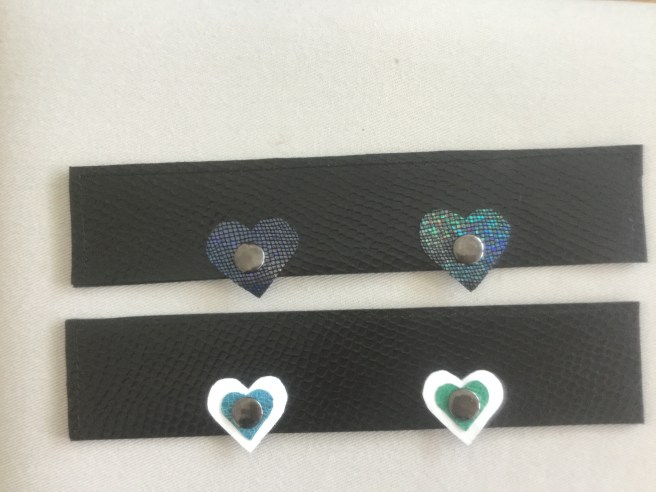
My friend Janka in Australia and owner of ThedaThreads on Etsy has created these fabulous, leather DPN-covers. She started to make coin purses, handbags and shopping bags with playful and fun designs. To help a fellow sock knitter with her needles falling out during transport, poking through my project bags and sometimes pricking my skin – Signature Needle Arts DPNs have stiletto points and are very sharp! – she designed these two cute and practical DPN-needle protectors. They measure 24 cm by 5 cm from edge to edge and fit a set of needles up to 20 cm length.

IMG_0219

I was so excited to receive them that I wanted to try their practicality right away. Plus, I had been working on a number of knit, crochet and spin-projects since the beginning of the year that all seem to take a lot of time to finish. So, an easy, fast pair of socks would just fit my need to have finally something to show in less than a month time. My yarn stash is slowly thinning, but a half ball of sock yarn was quickly found and is now on my needles.

The DPN protector made of sturdy, but flexible leather not only prevents the needles from sticking out, it helps keeping my knitting organised and the needles in the stitches. Being flat makes for easy packing into project bags and the extra 2 cm of leather can be folded over if a smaller space (e.g. my purse) may require it.

The photos above show how easily the knitting is put away in three little steps or removed when work commences. The fasteners work really well and close tightly. Little hearts add a bit of beauty to the protectors and give me a little, happy jolt every time I see them. The black, structured leather surface reminiscent of snake skin adds to the classy look of my new tools. I love them so much another pair socks will be on the needles as soon as possible.

Enjoy making! Maike

Modern Dance at NYUAD and Mussafah Art hub

A few weeks ago a friend of mine from New York City arrived with the Trisha Brown Dance company in Abu Dhabi to present one of their dance installations: “In Plain Site”. A fantastic piece which is presented partly on a stage and partly outside on the roof or balconies of buildings.

During the time the dance company was in town we had a period of very unusual and unstable weather with alternating sun, wind and rain. The morning I attended the show it rained so much that I had to use the front and back wipers on our car. That meant puddles had formed outside and the dance company adjusted their show to the “rain” alternative, an all-indoors presentation.

The first part was danced in the black box theater and the audience was captivated. Especially, the little ones were intrigued and didn’t want to sit still, but participate. Keeping their parents busy with stopping them from running onto the stage or crying over the music. It was requested that we didn’t take photos inside the black box and all the pictures seen here are of the second part, danced on the floor right outside the theater.

The dancer’s simple clothes and their pared-down, rhythmic movements made it a true delight for the eyes. It looked even better in the black box where the black floor provided a great contrast to the white-clad dancers.

Another opportunity to explore art arrived with an invitation from one of my groups to visit the Art Hub Abu Dhabi on a guided tour. It is well-known and located in Mussafah, an industrial zone a few minutes of driving outside of Abu Dhabi island. Therefore, it is not as easily found or accessed as many of the other art galleries in town, but the more interesting. The Art Hub is privately owned by Mr Ahmed Al Yafei who created this first artist community in the UAE.

Artists from different countries of the world are invited to stay at the Art Hub Mussafah and/or Liwa for a few weeks to explore the country and let it inspire them to create from their new experiences. When we visited we just arrived at the end of the Macedonian exhibit with some of the sculptures still on display in the main hall…

.. and the four new artists in residence from Russia starting to prepare for their upcoming show premiere. They were still very busy putting their last finishes to their paintings while we were shown around and had a glimpse of their residence and studio.

We also visited the permanent exhibition of art from previous visiting and local artists, a two-story building with a great variety of styles and materials. Most pieces are for sale and can be found and purchased here.

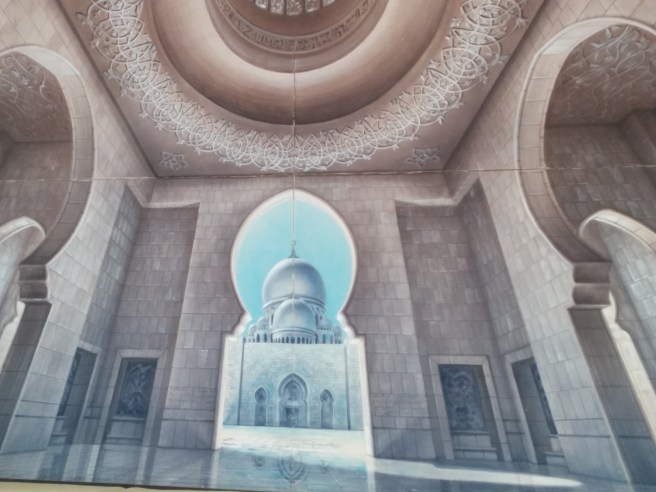
And one wall of the main exhibition for current shows had been painted with an eye-catching image of the Sheik Zayed Grand Mosque giving the illusion that one was looking into the actual mosque.

IMG_20170222_103100

This city and region continue to amaze and fascinate me. Thank you, for following me along my adventure! Until next time.

Yours, Maike


Overcoming a crocheting hurdle

If you read my blog a few weeks ago about reviewing some ‘works in progress’ (WIPs) you may have seen the note that the crochet flower poncho had been put into hibernation. But that did not mean that the project had left my mental space. Floating up as a thought once in a while and wondering what to do with it. To understand the wall I was up against I will start with my idea and vision of ‘my’ poncho. It was beautifully displayed on the cover of ‘Love of crochet’ magazine and I fell immediately in love with it. I had four balls of fuchsia pink to crochet with, but needed another 3-4 balls of cotton as per pattern. So, I bought some complimentary colours: a variegated white to fuchsia and a white to create a slow colour change from the bottom edge in white to light fuchsia to fuchsia around my shoulders.

Reading through the pattern multiple times there was no mention in which direction the poncho was being crafted or which side of the ‘assembly diagram’ was supposed to the the garment’s bottom or sides. During years of knitting garments and reading their measurement diagrams, those were usually displayed with the bottom edge at the bottom of the diagram. Even when the knit was beginning at one sleeve and knitting across the neck to the other sleeve the diagram would face the same way. Thus, I assumed it to be the same here. I didn’t realize until I had crocheted 10 flowers for my first row, held them stretched out along my shoulder-line from left to right, and wondering if I really needed the other 5, that I may have looked at the assembly diagram the wrong way. Going back to the photo which depicted only short sleeves, I thought my gauge couldn’t be that wrong ( I had measured the first flower and compared it to the given size in the pattern). This was the point when I examined the photo closer, counted the number of flowers in the middle from the bottom edge to the neckline and realizing that the ‘first row’ was being crocheted from the front over the shoulder to the back. Meaning that shown diagram showed me the side edge at the bottom. This was totally screwing up my colour transition plan! Forcing me to create vertical striping instead of horizontal. Not good and a full-stop to my crocheting for the next 3 months.

Thankfully, it all changed when another fellow knitter suggested to join their weekly crochet/craft group. This time I thought “Why not? May be, I will find motivation again to continue the poncho”. One of the nights before the first meeting I woke up in the early morning hours and couldn’t fall asleep again. Suddenly, it hit me: I could just alter the assembly pattern and turn it by 90 degrees on its side.

Perfect! That would change the look slightly with regards to the borders as now the more wavy border will be falling over my shoulders. Currently, I am working with 10 flowers in one row alternating with 9 in the next and will see how that will impact the setting for the neck opening since there were originally 11 rows = flowers along the bottom edge. As I am plotting along there are ideas popping into my head: how about creating the neck opening in row 8 by leaving out 4 flowers in the middle? That may work. If it looks askew, then I will execute Plan B and add another flower to the end of each row and see if that solves the potential issue…

Anyway, it is so much fun to crochet this project again and seeing it grow every week. I can’t wait to see the colour changing soon!

Thank you, for reading my blog and following my adventures in Abu Dhabi! Maike