
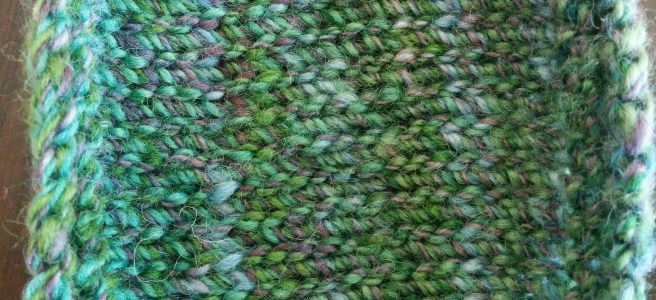

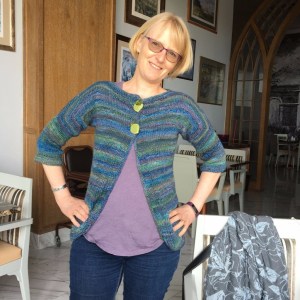
This cardigan has been on my mind and my needles for quite a while now. The process from spinning the wool, dreaming about what it would become, receiving the pattern, swatching a little and knitting, it has been a journey of trial and errors. A great learning experience. From the small swatch knit with a 3.5 mm needle I guessed that a 4.5 mm needle would give me the looser drape I desired for my finished garment. I know, this guessing and not knitting a test square (=swatch) is a pretty big “No No” for most knitters, but I like to knit “dangerously”. 🙂 Looking back at the pattern “The Icelandic over-blouse” – the pattern I decided to adjust for this cardigan – I knit about 18 months prior on 5 mm needles, when I reduced the all-garter stitch count by 10 for the front and back, I figured that a needle just 0.5 mm smaller would give me a similar, loosely fitting cardigan if I would add those 20 stitches in again. To enhance the look of my variegated yarn I chose stockinette for the body with a 6 stitch garter border. That changed the fabric to a less stretchy one as I found out when I was about 2/3 done with the body of the cardigan and realized the fit would be fairly tight. There wasn’t much I wanted to do about it as my yarn seemed to be scarcely enough to finish it with a decent length of sleeves. Then came the math part when I calculated where to set the markers for the sleeve increases. About 2 inches in I tried it on and all seemed wrong: the sleeves were too tight around my upper arm, the front parts were overlapping too much and the back was too tight. Unraveling was the only option and sitting, looking at the pattern and thinking where to set the markers for the next try. I learned that the markers for the front and back sleeve increase stitch need to sit a minimum of 8 stitches apart instead of only 1 to create a proper fit around the upper arm. In the end it resulted in a tighter fit around the back which I am happy with. Originally, once the sleeves were finished the cardigan would have been finished, too. But as it happens in hand-spinning the yarn was not uniformly thick and one of my garter stitch edges ended up pulling in from a few rows of noticeably thinner yarn. I was not thrilled by it and as there was some “good” amount of yarn left I thought to try an 3-stitch I-cord border. Starting at the rounded left side edge and continuing up the left front, neckline and then down the right front edge to the begin of the rounded corner. Stopping there would have been all right, but the I-cord edging would have created a dip at the transition point to the regular edge. Why not continue the edging along the bottom as there seemed to be enough yarn left to continue.


Well, my optimism often outpaces the reality in my knitting, especially, when it comes to estimates of how much yarn is left or needed. Now, the next decision needed to be made: unravel and leave only the front edge with an I-cord or find more yarn. I thought I had a small amount left aside somewhere and I started to look for the bag. Since I just had gone though a phase of re-organizing our small space and found new nooks and corners to stash yarn and fibre I was unable to find it for at least one day.
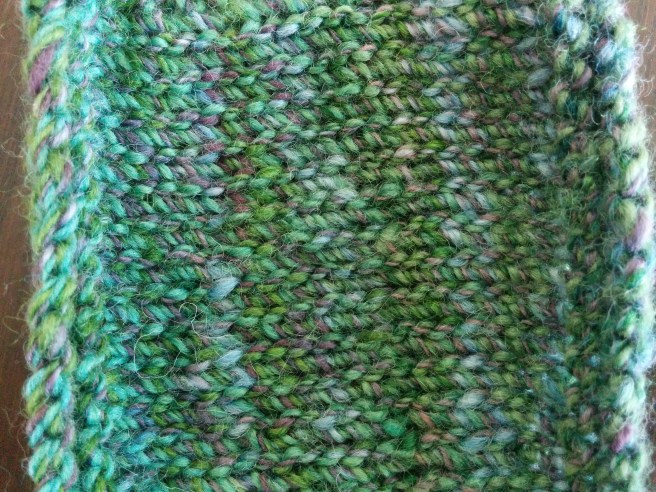
But there it was: The bag and in it a swatch of the green yarn. My savior to finish the I-cord edging. Now, let’s see how the fit will be after washing and blocking.
In the course of searching for the extra yarn/swatch I found this beautifully dyed Manos De Uruguay extrafine merino top braid and thought it would be a great addition to my Tour de Fleece spinning,


Tour de Fleece (TdF) is an online spinning event through ravelry and instagram in which people set a “winning” goal. Mine was to spin the three pencil rovings of organic cotton and to spin every day. The latter was easy and fun, but spinning the cotton challenged me and I was not too excited about the muted natural colours. The green roving was the solution and by using my Schacht spindle instead of a wheel I had a portable “to go” spin project for the days I would be travelling. It was real fun seeing the colours progress. The only downside is the colour transfer to my slightly moist fingers staining them a funny green. By the end of the TdF I had spun three skeins of cotton and about 1/3 of the green merino as singles.

Goals accomplished! The cotton skeins will most likely be knit into a small colour-work cowl, while the green merino singles are destined to be chain-plied into a 3-ply yarn. I am aiming for high-twist ply since I am planning to knit a pair of socks out of that gorgeous colour.

I wish you all happy spinning, knitting and crafting! Thank you, for joining me on my journey. Yours, Maike




 beecosydesign