January 2025: knitting small projects

The current image has no alternative text. The file name is: 20250209_144011-collage.jpg

For the past three years I have been working on reducing my stash and decided to measure my success by counting the meters of yarn bought and the meters of yarn knit or crochet out. In most years I manage to knit/crochet about 12,000 m and tried to be focused to buy less: around 10,000 m/year. Since I have not added up all the yarn I had already collected I am just happy to know that I am not adding to my stash.

Still, the space taken up by my yarns and fibres seems to expand instead of shrinking. Leading me to figure better ways to use more yarn. May be, using yarns doubled up will do the trick?

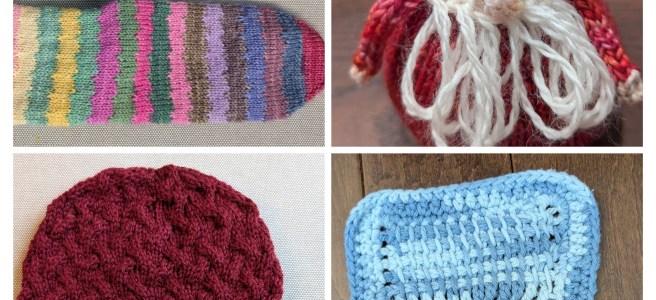
January saw four small projects accomplished: A pair of socks in size 8 knit out of CozyKnitters https://www.thecozyknitter.com/ Advent 2024 sock yarn. The two skeins yield two pairs of socks and I had hoped to knit one pair before Christmas by knitting one or two stripes a day and the other between Christmas and New Years. Since Canada Post was on strike until Dec 17th the yarn arrived on Dec 23 and the second pair came off the needles in January with about 195 m used.

On a visit to Victoria I found the Book “Gnomes of Grimblewood” by Sarah Schira in the Button and Needlwork Boutique https://www.buttonedup.com/. Just looking through the book makes me happy and I decided to join the ” Knit a Gnome every month” Knit-Along by the Sarah on Ravelry. For January I knit “Gnoodles” https://www.ravelry.com/patterns/library/gnoodles (about 20m of Pretty String Pretty soft yarn https://www.prettystring.ca/yarn-bases ). So much fun! February’s gnome will be “Gnorri”.

To transfrom a swatch of tunesian crochet from a course last year to a dishcloth I added a few rows of crochet for a larger size and used up 10 m of Paton’s cotton.

On the same weekend trip I bought a skein of Rowan Cashsoft (137 m) and made sure I knit it into a hat in the following weeks. I adapted the Sweet Felicia pattern https://www.ravelry.com/patterns/library/sweet-felicia to fit the DK yarn.

My total tally for the first month of 2025: 230 m left my stash after subtracting the 137 m purchased.

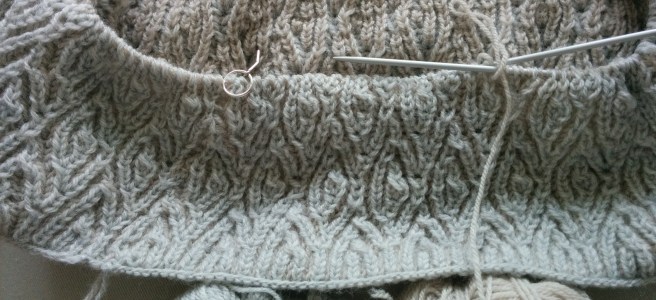
In the background I am working on some larger projects: A brioche sweater in a natural white merino chashmere lace held triple. I will write a bit more about it next time since this seemingly simple looking sweater had my stuck a few times and put in “time-out” for a few weeks at a time. No wonder it still isn’t finished after 6 months.

The other time-consuming goal is spinning about 600 m of a three-ply yarn from Merino and Corriedale fibre blended with baby camel to knit the Pelica vest. This is a “blend the fibres, spin and knit”- study my spinning group is attempting with a number of us planning to pose for a photo together in our Pelica vests in late summer.

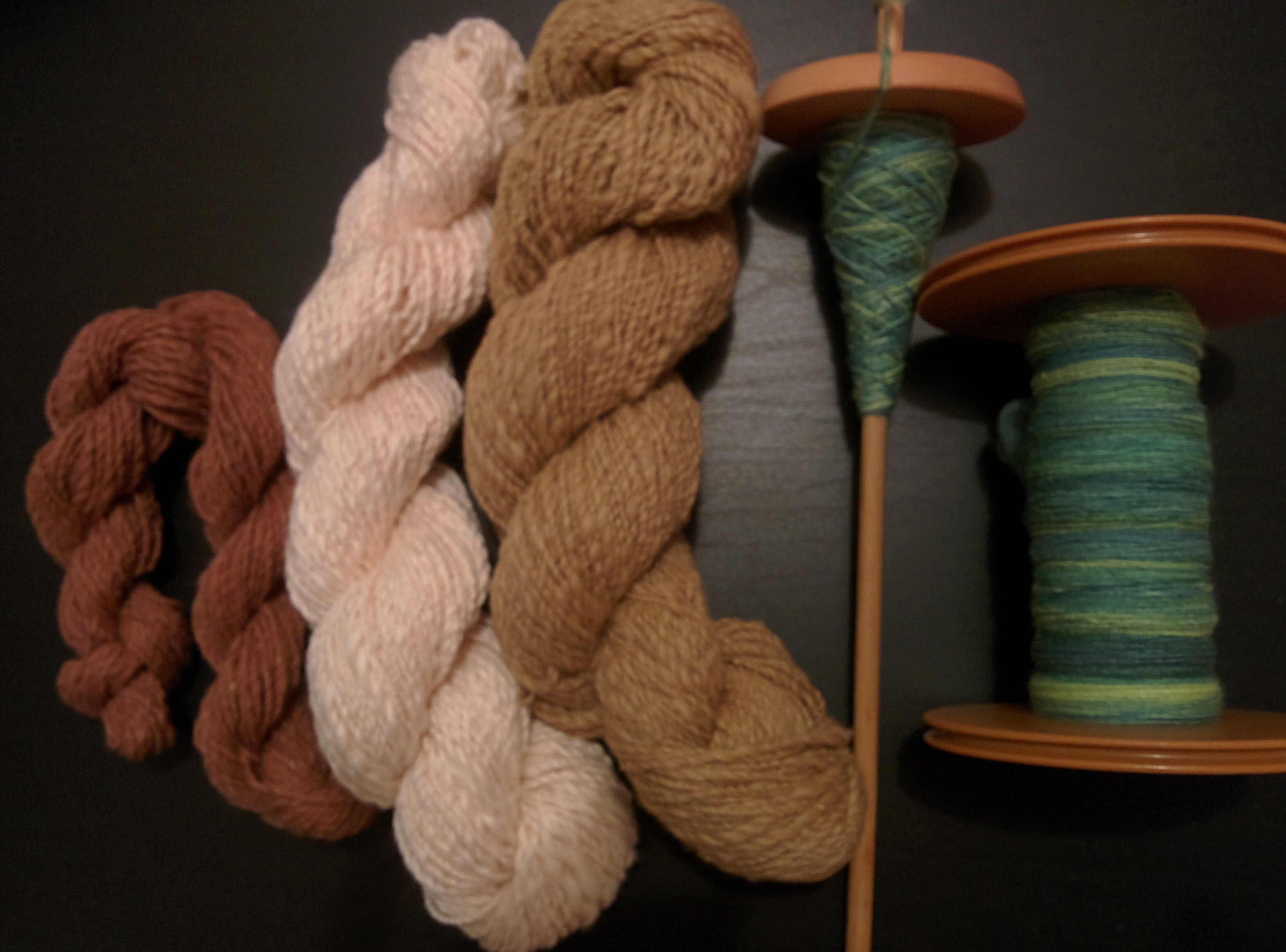
My first ply of the yarn is spun from this New Zealand wool (Corriedale dyed in Alaska) purchased on our last cruise to Alaska. Topped with the baby camel fibre for blending.
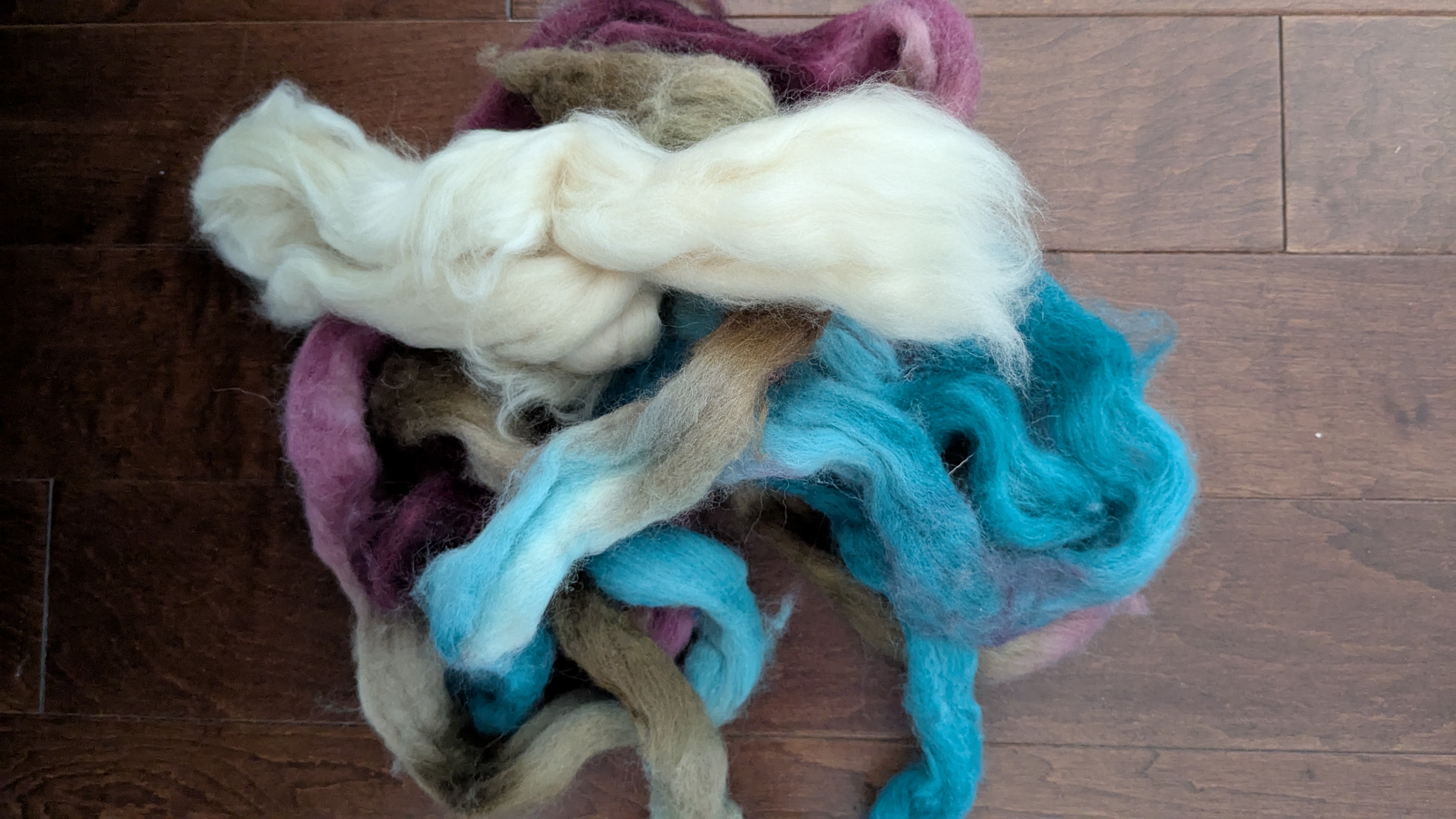
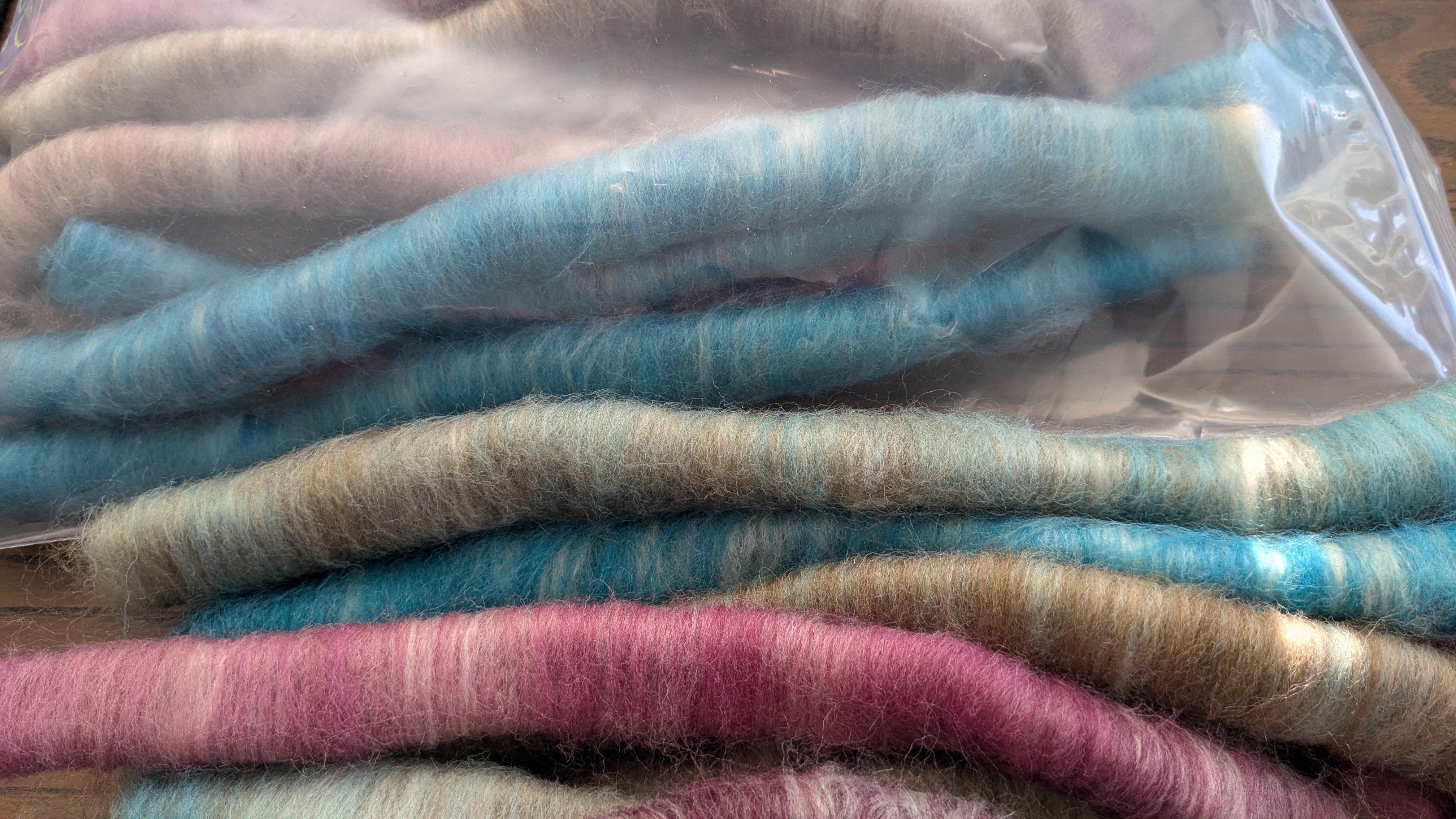
After splitting the roving braid in half I separated each half into about 12 strips pulled apart where the colour changes were happening for a total of 24 strips. Then I separated the camel fibre into about 24 equal pieces as well and started blending on my blending board for 24 rolags.

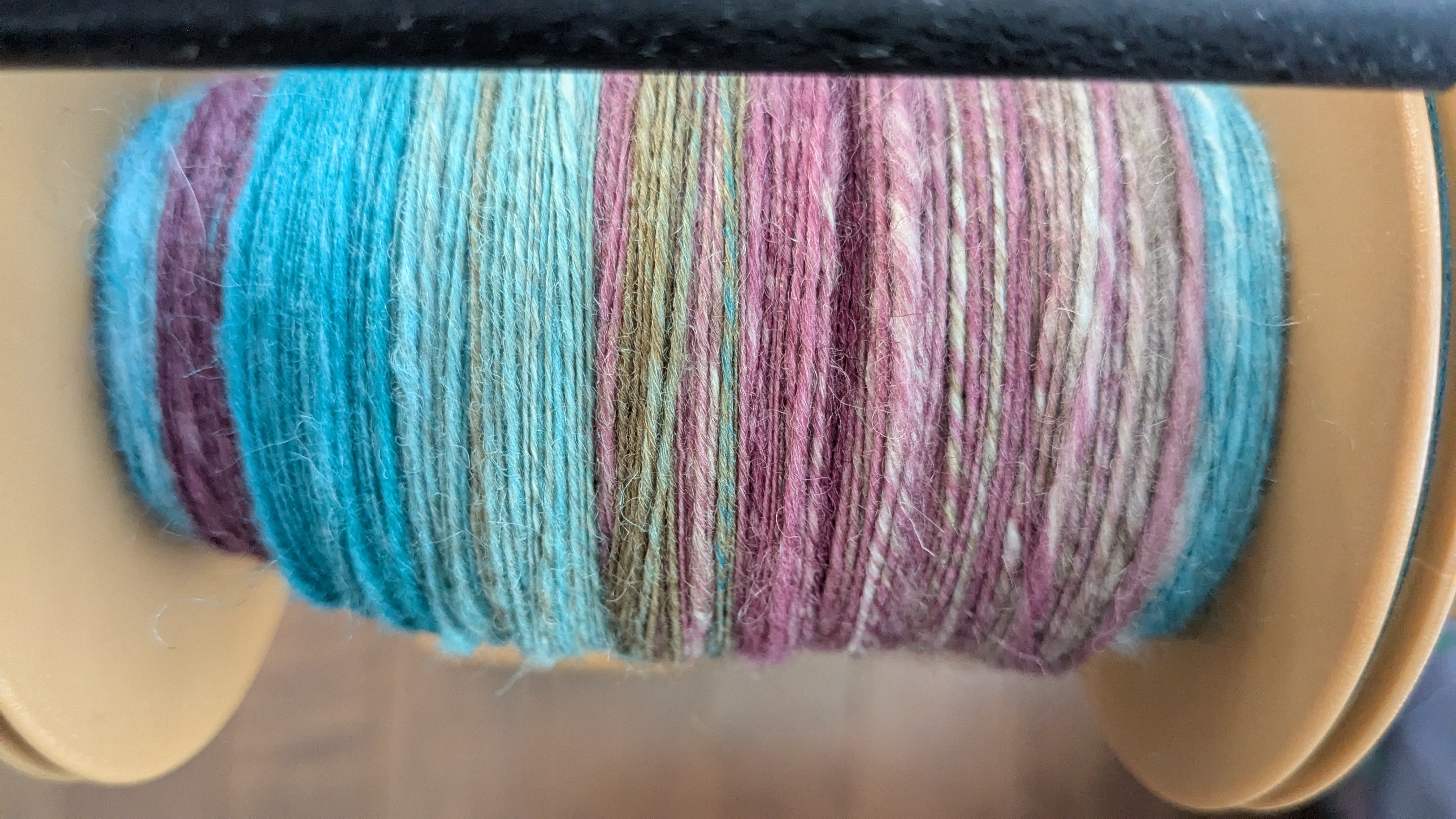
Knowing that I needed about 600 m of this single I used a backward semiworsted drafting method for more loft and counted my drafts (about 10 cm each time) to yield about 250-300 drafts per rolag (equal to about 25-30 m). That should have resulted in 600+ meters. I will learn the yield after spinning my other two braids and then plying the yarn. The current spin looks pretty and makes me happy!
Have a great week and Happy Valentines Day to all!

Mika
Crafting plans for 2018

After a busy December we finally had some quiet time in Abu Dhabi which allowed me to think ahead of the year to come. As I feel that big plans for where life may go this year are difficult to formulate at this point of time I am confident that I have a bit more control over what I would like to achieve in spinning, knitting and crocheting. I have come to the conclusion that I definitely want to work with the yarns and fibres on hand and not splurge into more shopping for a few more months. My first two projects on my needles are a pair of colourwork socks and a two-colour-brioche cowl.

The colourwork socks are a copy of Kerstin Balke’s Soxx No. 15 from her book SoxxBook by TOPP publishing. I am knitting 56 stitches on 2.25 mm needles and have modified the heel from a gusset to my boomerang heel and used the mustard yellow as a contrast instead of the petrol in the white rhombus. The yarn used is Lang Jawoll superwash composed of 75% virgin wool with 25% Nylon and a super-soft hand. This pair of socks came about when I was visiting a yarn store to buy some knitting needles for my mother and my dad pointed out the book and a sample of these socks. The colours spoke to me and a few minutes later I bought the mustard yellow, petrol and light blue. So much for not buying more yarn….:) I love knitting them and am happy I was tempted.

The cowl is the result of many weeks of deliberating how to show-cast the wonderful squishy-ness of four balls of Mondial BiolanaFine made of 100% organic wool created in Italy. I received the two balls of gray and beige each in August and had been dreaming about knitting with them for a while. Finally, I could use some larger needles again: a 3.25 mm and have a smaller item to finish which will take a month to accomplish. It took some trial and error to arrive at this pattern. I first tried a PurlSoho pattern for a big three-color and slip stitch cowl, but noticed during swatching that one of the stitch pattern didn’t feel as soft to the touch as I would have liked. With too much of purl stitches showing at the surface the yarn took on a scratchy feel and lost its soft squishy-ness. So, I went back to look for a two-tone brioche scarf or cowl and found the Tistou cowl by Nadege Dereppe, a free pattern on Ravelry. It is a bit more difficult than a plain brioche pattern, but a challenge that I was up to. Once I understood how to read and knit the brioche pattern, especially what counts as a stitch when knitting together two (it means a stitch and a stitch and its yarn-over=brioche stitch), it became a pleasure to work on. I adjusted the stitch count to 220 as I prefer a less wide cowl and I will probably double the height to use up most of the yarn. The resulting fabric has a great structure and wonderful softness to it.

My spinning goal was an easier one to set. I liked the “Spin the bin” challenge hosted by the Completely twisted and arbitrary (CTA) group on Ravelry.com in 2017 and decided to try it again for 2018. This time entering about 12 ounces more of fibre than last year and some plans for what I want to spin for. This challenge will tackle the majority of my current fibre stash and open up opportunity for replenishing it later this year. The first two braids of alpaca fibre (Alpaca named “McDreamy”) from a farm in Saanich (Vancouver Island, BC) named Inca Dinca Do. One became a sport- to DK-weight 2-ply of 210 m/100gm (S-spun singles and Z-plied) which will be knit into a Dean Street hat by Nina Machlin Dayton to replace a hat I had knit for my husband and lost 2 years ago.

The second 100 gm of alpaca will be spun into a 3-ply with no planned use as of now. Depending a bit on how thin and long I manage to draft the fibre.

Last year I had started to dye some fibre and yarn and decided to start the year with a dyeing session. I had hoped to work through 150-200 gm of fibre in roving and locks and 2 x 100 gm skeins of yarn. But after 4 hours of leaning over the table to mix and apply colour I was tired and my back ached. Three colourful braids and 45 gm of Polwarth locks were the result, but no yarn.

One of the braids will be added to my blue fibres in the Spin-the-Bin 2018 collection to achieve 400 gm of fibre and a sweater quantity’s worth. The red braid may become a pair of short socks if spun thin enough. It may be a big challenge with less than 50 gm of fibre.

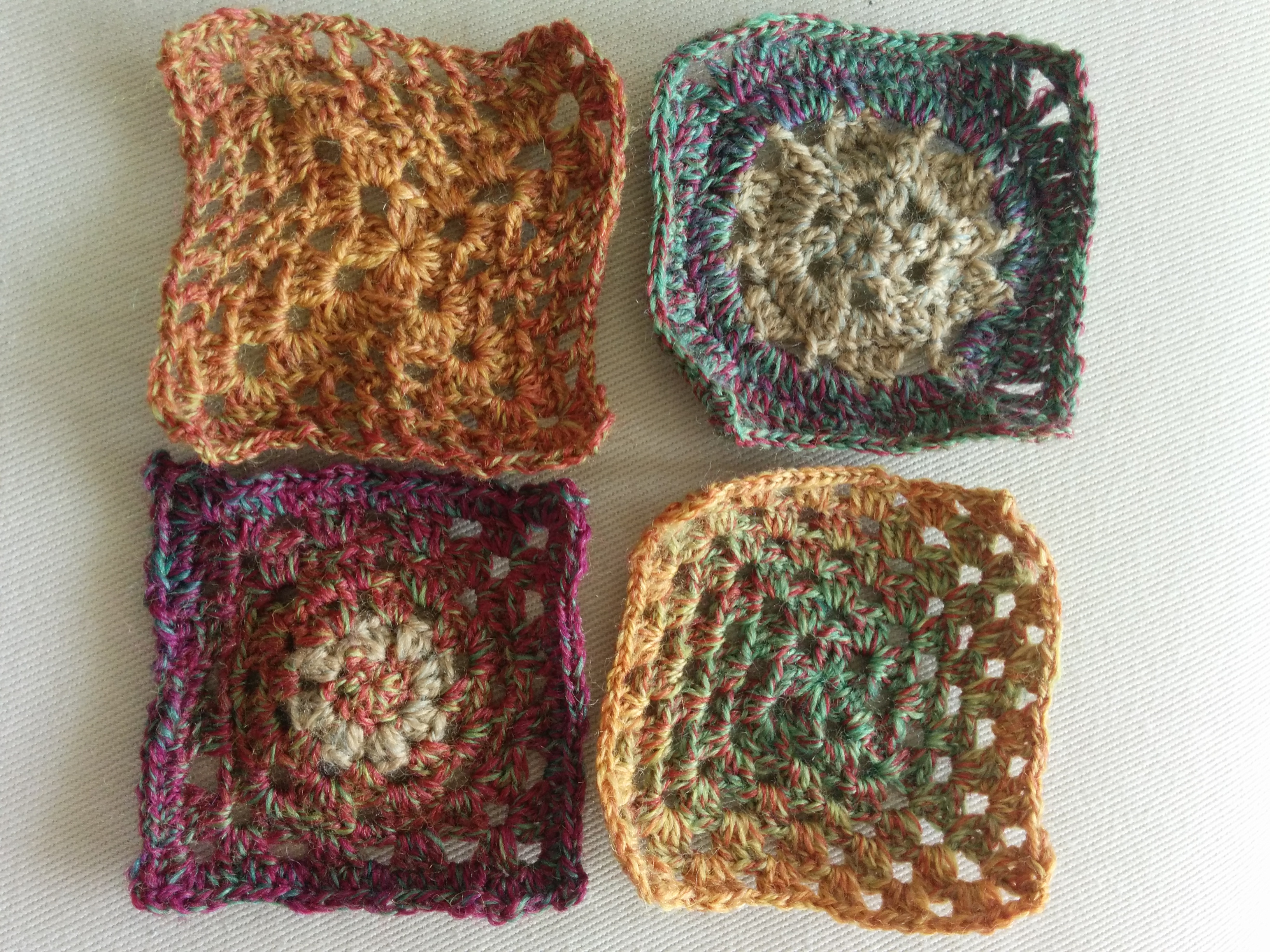
The biggest planning challenge was my next crochet project. I guess after 18 months working and thinking about the flower poncho and finally finishing it just before 2017 year’s end there was a big emptiness. I just couldn’t come up with any ideas on what to crochet. I knew what I didn’t want: an household item or accessories. At last a blanket was my choice and preferably with the yarns I have around. Two gradient-colour sock yarns had been added last year with some thoughts of knitting a shawl or socks with them, but nothing materialized so far. Now, the un-dyed two skeins of white sock yarn came in handy as a contrast and joining colour since I decided to sign up for a facebook group 2018 Granny Squares CAL. This group posts a new granny square pattern for every day of the year and after thinking, this may be a little crazy to crochet a square a day, I became hooked and finished four squares (without blocking) yesterday. I know I will not keep up that pace, but felt I wanted to catch up with the 20 days I missed this month.

IMG_20180122_094210
First four granny squares towards a blanket for 2018

The squares turned out to be about 8 x 8 cm square without a border (2.5 mm hook) and before assembly. If each square after joining will measure 10 x 10 cm then about 200 will be needed for a 1 m x 2 m blanket. As I do not plan to crochet every pattern that will be a great number and an interesting blanket as a result.

Thank you, for your interest in my blog. Until next time, Maike

Saved by a swatch!

IMG_20170720_105652
Just before the swatch was unraveled  

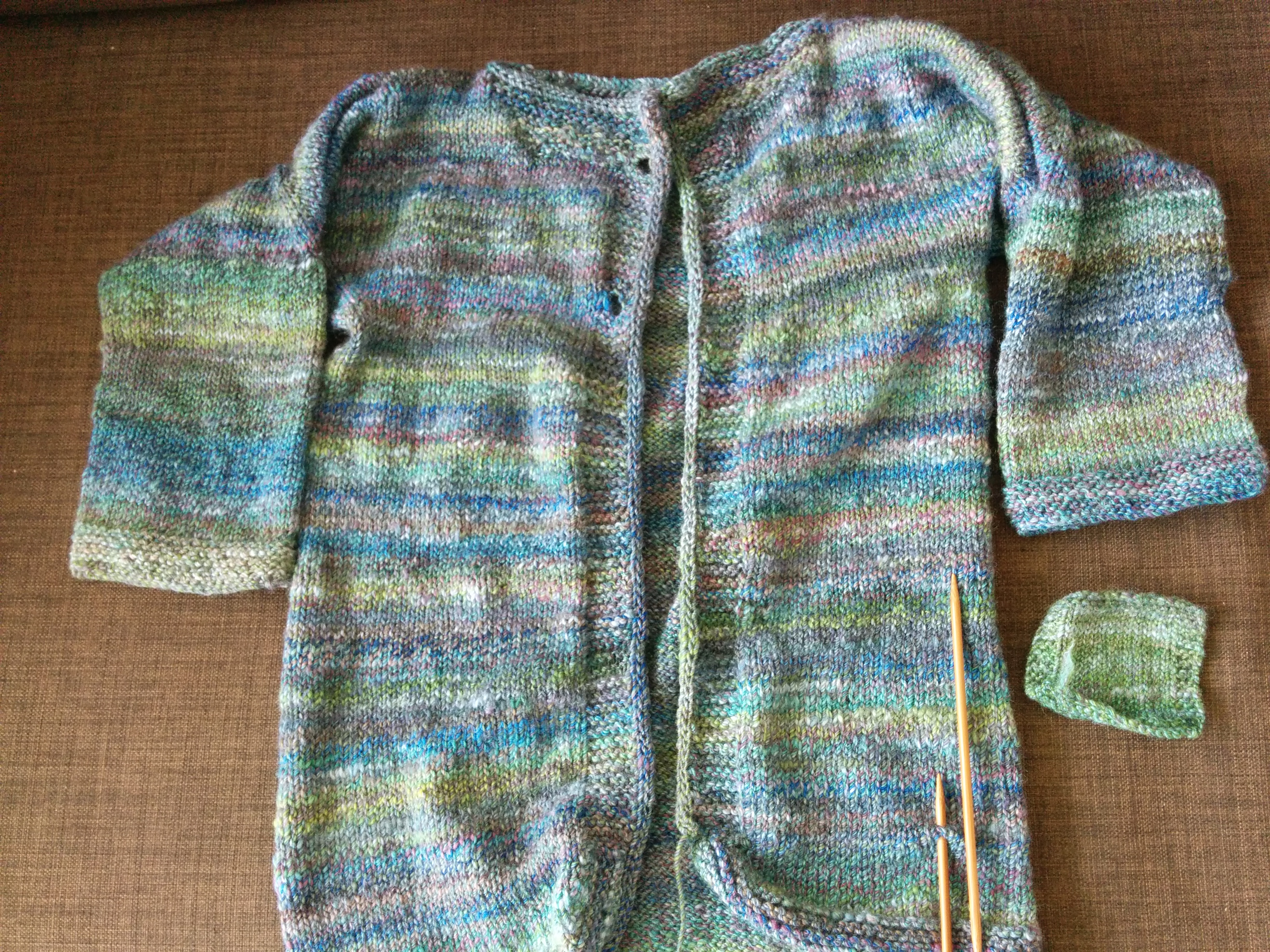
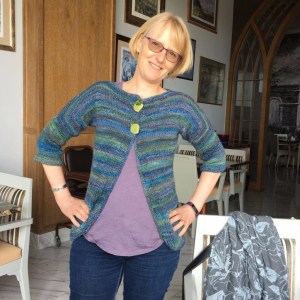
This cardigan has been on my mind and my needles for quite a while now. The process from spinning the wool, dreaming about what it would become, receiving the pattern, swatching a little and knitting, it has been a journey of trial and errors. A great learning experience.  From the small swatch knit with a 3.5 mm needle I guessed that a 4.5 mm needle would give me the looser drape I desired for my finished garment. I know, this guessing and not knitting a test square (=swatch) is a pretty big “No No” for most knitters, but I like to knit “dangerously”. 🙂 Looking back at the pattern “The Icelandic over-blouse” – the pattern I decided to adjust for this cardigan – I knit about 18 months prior on 5 mm needles, when I reduced the all-garter stitch count by 10 for the front and back, I figured that a needle just 0.5 mm smaller would give me a similar, loosely fitting cardigan if I would add those 20 stitches in again. To enhance the look of my variegated yarn I chose stockinette for the body with a 6 stitch garter border. That changed the fabric to a less stretchy one as I found out when I was about 2/3 done with the body of the cardigan and realized the fit would be fairly tight. There wasn’t much I wanted to do about it as my yarn seemed to be scarcely enough to finish it with a decent length of sleeves. Then came the math part when I calculated where to set the markers for the sleeve increases. About 2 inches in I tried it on and all seemed wrong: the sleeves were too tight around my upper arm, the front parts were overlapping too much and the back was too tight. Unraveling was the only option and sitting, looking at the pattern and thinking where to set the markers for the next try. I learned that the markers for the front and back sleeve increase stitch need to sit a minimum of 8 stitches apart instead of only 1 to create a proper fit around the upper arm. In the end it resulted in a tighter fit around the back which I am happy with. Originally, once the sleeves were finished the cardigan would have been finished, too. But as it happens in hand-spinning the yarn was not uniformly thick and one of my garter stitch edges ended up pulling in from a few rows of noticeably thinner yarn. I was not thrilled by it and as there was some “good” amount of yarn left I thought to try an 3-stitch I-cord border. Starting at the rounded left side edge and continuing up the left front, neckline and then down the right front edge to the begin of the rounded corner. Stopping there would have been all right, but the I-cord edging would have created a dip at the transition point to the regular edge. Why not continue the edging along the bottom as there seemed to be enough yarn left to continue.

Well, my optimism often outpaces the reality in my knitting, especially, when it comes to estimates of how much yarn is left or needed. Now, the next decision needed to be made: unravel and leave only the front edge with an I-cord or find more yarn. I thought I had a small amount left aside somewhere and I started to look for the bag. Since I just had gone though a phase of re-organizing our small space and found new nooks and  corners to stash yarn and fibre I was unable to find it for at least one day.

IMG_20161005_082901
This square of yarn helped finish the cardigan…

But there it was: The bag and in it a swatch of the green yarn. My savior to finish the I-cord edging. Now, let’s see how the fit will be after washing and blocking.

IMG-20170725-WA0001
Hot off the needles and finally finished..

In the course of searching for the extra yarn/swatch I found this beautifully dyed Manos De Uruguay extrafine merino top braid and thought it would be a great addition to my Tour de Fleece spinning,

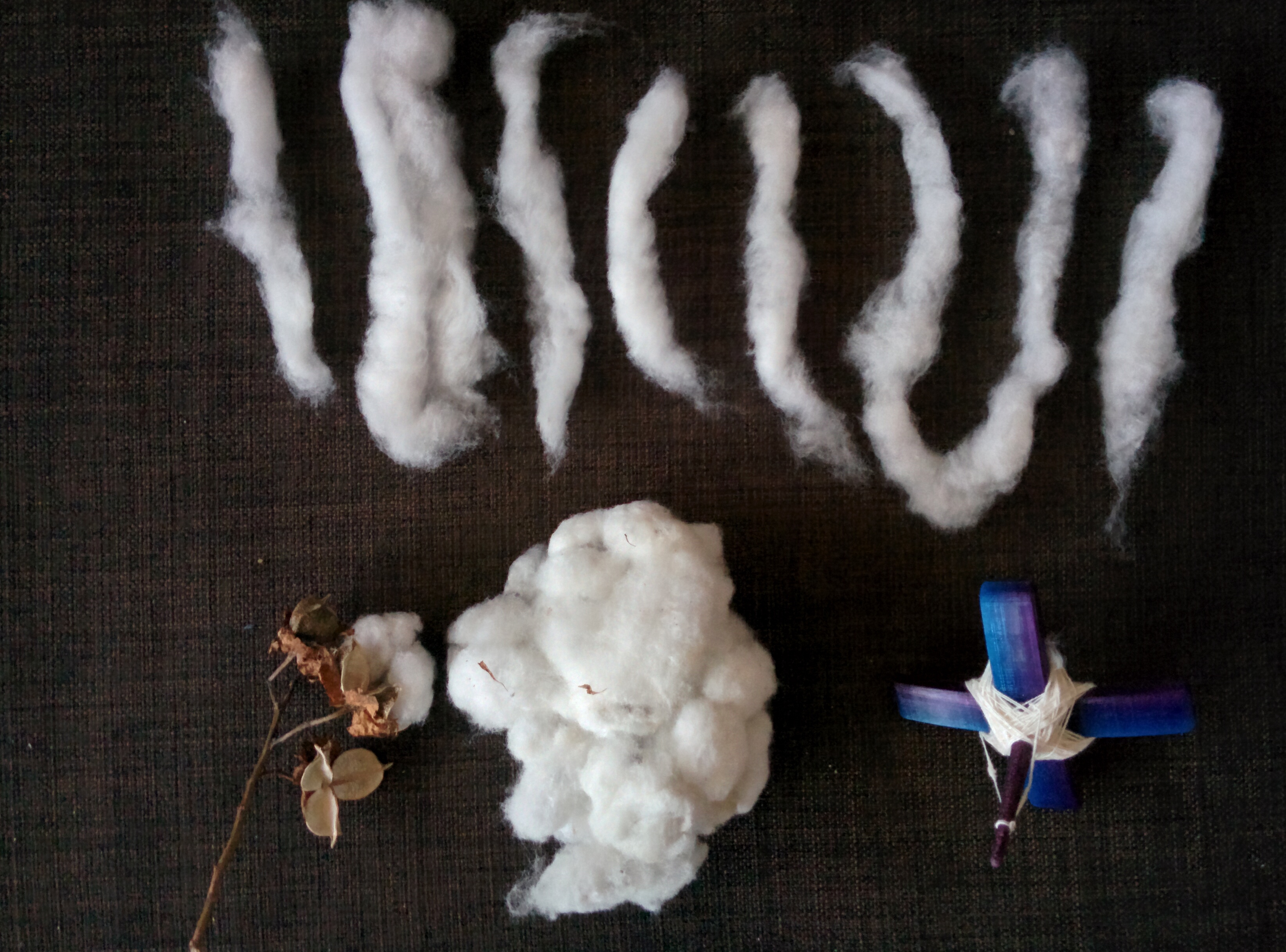
Tour de Fleece (TdF) is an online spinning event through ravelry and instagram in which people set a “winning” goal. Mine was to spin the three pencil rovings of organic cotton and to spin every day. The latter was easy and fun, but spinning the cotton challenged me and I was not too excited about the muted natural colours. The green roving was the solution and by using my Schacht spindle instead of a wheel I had a portable “to go” spin project for the days I would be travelling. It was real fun seeing the colours progress. The only downside is the colour transfer to my slightly moist fingers staining them a funny green. By the end of the TdF I had spun three skeins of cotton and about 1/3 of the green merino as singles.

IMG_20170723_221353
Three 2-ply skeins of cotton (45 – 156 m) and single ply merino (~35 gm)

Goals accomplished! The cotton skeins will most likely be knit into a small colour-work cowl, while the green merino singles are destined to be chain-plied into a 3-ply yarn. I am aiming for high-twist ply since I am planning to knit a pair of socks out of that gorgeous colour.

IMG_20170717_063816
Birthday breakfast…

I wish you all happy spinning, knitting and crafting! Thank you, for joining me on my journey. Yours, Maike

Summertime in Abu Dhabi

All right, it is summer here! With temperatures hovering above 40 C for most of the days and some nights our outdoor time has been reduced to a few minutes here and there. Any other attempts – a four-hour golf game in the morning or a longer than expected walk from a bus stop – and one is in for the risk of headache, overheating and heat stroke. Even with drinking plenty of fluids, trying to stay in the shade as much as possible and a little breeze it is pretty much impossible to escape the heat. It is like walking in an oven. This has an curious impact on our activities and seems almost to mirror what effect a winter in Canada would have: one spends endless hours inside with a lot of sitting and eating, interspersed with a little walking. Luckily, this is a time as well that allows for a greater focus on all my crafts. To keep my motivation up I try to go to the crochet and knit meetings and I signed up for “Tour de Fleece”  (TdF) with the “wool n’spinning” group which is a fibre spinning event running during the Tour de France. The group members motivate each other with posting pretty photos of their current spin and finished yarns. My goal is to spin through all my cotton (about 140 gm) in earthy colours of natural dark green, white and brown. I had hopes for a more consistent and thinner result, but am ok with the rather rustic thick-and-thin look of the dark green 2-ply braid in a heavy fingering/DK weight. The white pima cotton I just started to spin behaves even more obstinate with the fibres trying to fly away and not liking the long-draw/woolen spin. Figuring out which draft (a supported woolen, may be?) and which uptake will work best will challenge me for the next little while.

In preparation for the Tour de Fleece my motivation soared and one day I finished cleaning all my bobbins – resulting in two mini skeins -, a 3-ply cat hair yarn and a pair of socks for my husband. I don’t think I have finished so many different items in one day and was proud to have three (small) skeins of yarn and a knitting project to show for it.

Another group I want to sign up for is “Stashdash” run by the ladies from the “Knitgirllls blog”. It is a group event where one is trying to get as many items finished between May 26th and August 20th and post about it in the Ravelry group. Almost everything in spinning, crocheting and knitting counts towards it as long as a few rows or meters of the finished item have been done in that time frame. Since one can sign up for different levels starting at a 1,000 meters and going up to 15,000+ meters I am quite busy knitting on my blanket and my cardigan. The latter could have been finished a few weeks ago if I weren’t distracted by making sure I spin every day for the TdF and not being able to lug the cardigan around with me as easily as the blanket squares. I have not declared my level, yet, as I am hoping to finish with 5,000+ meters and one can declare a few days before the deadline. The blanket will account for about 2,900 m, the cardigan for 700 m, the socks for 300 m and the spinning for about 1,000 m by August. It could be possible….:)

The blanket and the cardigan will be finished by the deadline for sure. But to keep hope alive that I might even be able to reach the 7k-mark I started a free-style half-circle shaped lace scarf which could add another 600 m to the goal. Who knows how much spun yarn I can add to the total – and voila!?!

As much as I love to sit and knit, spin and crochet I sometimes miss a bit more of a mental challenge and to keep things going I am continuing my Arabic lessons. It is a smaller class this time and I think it will be more effective as it runs twice a week for 8 weeks.

I hope you are having the most beautiful and crafty summer in your area of the world! Thank you, for reading my blog.    Maike

Crochet and knitting for charity

Travel has been the focus of the past few weeks and in the past I regarded it as an opportunity for dedicated knitting, crocheting or spinning time. Sitting on a plane or in a car or train is perfect for uninterrupted crafting, I thought. Well, that was until I realized that the time of travel – night flights, especially, I spent sleeping – and the destination – in cities we walk a lot – does make a huge difference. Thus, finding that progress does not come as quickly as imagined. After knitting a lot of items for personal or family use it was time to invest into some charity crafting. The first opportunity came through my weekly crochet group where a few weeks ago the organizers handed out some yarn and two patterns to crochet squares for a blanket. I was excited to try new patterns and learned how to create cables and little nubs in crochet. Plus, it broadened my knowledge of crochet abbreviations. A great learning experience!

Another opportunity to knit something for a good cause came when one of the local Meetup groups announced an “April: month of knitting for charity”. I jumped right in with some leftover, easy-care yarn and a style of knitting I wanted to try for a while: Mosaic. To create the mosaic pattern one alternates colours every two rows and only knits one colour at a time. The intricate patterns occur when some stitches are not knit but slipped from the left to the right hand needle. Creating an elongated stitch that carries the colour to the next colour change row. It looks a little like bars and lines assembled to create a graphic pattern best shown off in two strongly contrasting colours. That is an improvement to be make next time. I think I fell in love with this style of knitting and am plotting another hat or may be even a scarf to see the possibilities.

My other two projects are coming along with the crochet flower poncho on its second darker pink row nearing the neck hole opening.

The “Icelandic blouse” variation cardigan knit in my hand-spun had a little “hang-up” when I tried it on for sizing after closing the shoulder seams and found it very tight around my body. As the plan is to affix two buttons to the top part it would fall quite open over the stomach area. Which I really didn’t want to pronounce that much. So, there I was deliberating my options:  1. unravel all my knitting at least three weeks worth and knit it an inch wider since I now knew I had enough yarn or 2. let it go, hope that it can be blocked another 3 inches wider – Hey, its wool! It may work! 🙂 – or think of something else. These options had to sit  with me for a while and percolate until I was comfortable to decide. At last, the seams were unraveled, four more rows were added for more ease in the sleeves and a tiny bit more length in the body. Now the shoulder seams are closed again and stitches for one sleeve have been picked up and are knit in the round with a 2-stitch decrease every 20 rows. I think I will be happy with the cardigan even if falls open on the lower part.

The cotton grown in Abu Dhabi has been all spun up and became a fingering- to sport-weight 3-ply yarn with about 40 m of length for 15 gm of cotton. It is really a very small amount, but still took some hours to finish. The most difficult part being the plying from the “turtles” of my Turkish spindle. Even though, I tried a lazy kate set-up the the singles didn’t move easily and sometimes broke. In the future I will try and wind the “turtles” onto a plying bobbin and hope that will make it a smoother experience. Now, I am happy to return the yarn to the owner of the cotton plant.

One of the plans I made before moving to Abu Dhabi was to start dyeing my own yarn or fibre. I had taken an introduction afternoon with a friend of mine in Vancouver and purchased Greener shade dyes which moved with us last May. In July last year I had another dye-session with a friend from my local knit group using all food-dyes and learned another technique.It was a good reminder what other equipment (buckets for rinsing, vinegar for the dye-solutions, etc) I needed to acquire before I could start. The buckets – old, large yogurt containers were easy to collect – and the used microwave dedicated to yarn dyeing arrived in November last year as a gift from another fellow knitter. So, there was really no reason to not start earlier. But I was worried about potential spills or contamination of the apartment when weighing out the dyes which still contain some heavy metal components, albeit less than other brands. But before the anniversary of my arrival in the UAE came about I set a day and just started. Making the stock solutions took an surprising amount of time almost preventing me from being able to at least try them out once before the weekend arrived. I wanted to see if my Depth of shade (DOS) of 2% would work when diluted 1:2 with a 50% vinegar solution. During the preparation of the stock solutions I noticed that some of them ended up being a suspension with a bit of sediment on the bottom. My balance for weighing the powder only shows weights down to 1 gm and I knew that weighing 2 gm would not be very accurate. In the end it all did not matter that much. I do not plan on recreating colours exactly at this point of time and despite the sediment all colours diluted well with the vinegar and dyed the 40 gm of roving in a lovely rainbow. I can’t wait to spin it up and see the colours dancing along.


Thank you, for following along my crafting and travels for the past year! Maike

Continuing works in progress and a few finished objects

It has been a few weeks since I last posted a more in depth review of my current knit, crochet and spin projects. I felt there was not much to be reported despite working every day at least for half an hour on one of them. For that reason a pair of socks were chosen to have at least one finished object for March. The test knit cardigan Abu Dhabi Soft  by Meiju was my February finished work. It is now published and the pattern can be purchased here.


My slow progress was partially due to hosting guests for about four weeks over three months, partially because I took classes throughout the month of March. My motivation to craft is highest when I have few distractions and can spend longer patches of time on knitting. It seems to increase my productivity…

Some of my works in Progress (or WIPs) are old acquaintances: The crochet poncho grows by about 5 flowers each week when I go to the local Wednesday crochet group. At that speed it will take me another 20 weeks or more to finish it. So, you will be able to watch the growth in very slow motion. The other “seemingly endless” WIP is my pinwheel blanket. 10 squares have been finished and in the current colourway I have enough yarn for another 2 squares. Once the last two squares will be knit I want to decide if a. to stop and leave it at lap blanket size (about 100 x 120 cm), b. knit more squares in another colourway to add or c. Buy some white yarn and knit a border around each square and then knit them all together into a blanket of about 160 x 170 cm. I found an example for a mitered-square blanket with borders here.

Even though this should be plenty to keep me entertained, I crave knitting with my hand-spun 3-ply in sweater quantity I finished spinning in 2016 and had wound into cakes “ready-to-go” in January. While I was knitting on the Abu Dhabi Soft cardigan and mentioning in my blog a little while ago that I was trying to remember a Elizabeth Zimmerman pattern for my hand-spun yarn a dear friend of mine found the pattern and sent a copy.  There was no time to be wasted and it was started around March 19th. I am really happy about the progress as it grows rather quickly on the 4.5 mm needles. My latest Project is a hat for charity to reduce some leftover yarn. Additionally, it gave me the opportunity to try one of Barbara Walker’s mosaic patterns from her book “Charted knitting designs”- Four armed square with arms bent eight times. I am enamored by the intricate look, especially in garter stitch and the easy knitting.


Spinning has been taking a fair amount of my time as well. In January – before I agreed to the test knit – I signed up for the “spin the bin” challenge in the Completely Arbitrary and Twisted (CTA) spinning group on Ravelry. I learned about this challenge from Rachel at Welford purls. One declares at the beginning of the year which braids and fibres one wants to spin, a minimum of 24 ounces = 720 gm. That does not sound like much to some spinners, but it will take me about three and a half months to spin my first 12 ounces of 28 declared. It is basically a challenge to use as much fibre out of my stash as I can to free up some space. This created the goal to knit more from my hand-spun yarn this year and reduce buying yarn to a minimum. Easy, as long as I stay out of yarn stores while travelling..:)

When I read the winter issue of Spin-off magazine in December and January I found an article ” A sweater from my backyard” about sourcing local fibre and working with dye colours available to us in our surroundings. This article had reinforced the idea to find local farmers of sheep or camels here in Abu Dhabi and procure some of their fibres. This has been proven utterly difficult since access to agriculture seems to be for the local people only. Lacking Arabic has not helped neither, as the few crafts people I meet at fairs are often elderly and were educated before English was taught at school. But without looking two opportunities of unexpected fibre have entered my sphere of spinning. The first one is cotton: one of my friends noticed an ugly tree/shrub in her garden and asked the gardener to remove it when he chided her for wanting to kill a valuable tree. With not much watering the tree started to grow cotton flowers that could be harvested. Now, I am in the possession of 15 gm of natural white (and organic) cotton fibre, hand-picked and cleaned from the seeds that I am spinning with my turtle lace-spindle into thin singles. I hope to create about 30-50 meters of a three-ply yarn to return to the cotton-owner to create a memento of her time in Abu Dhabi.

IMG_20170405_183328

The second local fibre too explore will be described in my next crafting blog. Until then – thank you for following my adventures in the Middle East.

Happy crafting! Maike

How to measure a month of crafting

January 2017 already passed and I wondered where the time has gone. Looking at world politics big changes are afoot and worry about humankind’s future are creeping into my mind. I find refuge and happiness in crafting and sharing my excitement about knitting and spinning with anyone who asks. Despite, knitting at least a few rows every day and of late some spinning at my wheel I find I have no finished object to show for all the work. Certainly, it has to do with the size of items I am working on and the preparations to get to the production stage. Plus, living life with family and friends gets me easily distracted. My expectations to have something ready-to-wear or use to show may be heightened by my online following of some fellow craftspeople who I admire for their lively video-blogs and amazing line of finished items to show every week or two. The most prolific and fastest knitter is Mina of the Knittingexpat-Podcast. I love listening to her adventures in sock knitting, designing her own patterns fro scarves, socks, hats and baby garments intertwined with her life journey from the UK to expat life in the Miiddle East and now New York. Not surprisingly one of her published patterns the Pinwheel scrap blanket is one big item I am knitting on.

It all started with my mental review of knitting, spinning and crocheting of 2016 and thinking of what I really enjoyed. I realized that I wanted to spin more for sweaters or big scarves and feel less “obliged” to work through my store-bought yarns. One result was the decision to unravel a scarf and use the yarns for a different purpose. May be, socks. The other to let my crochet flower poncho hibernate for now. My motivation to continue was already dampened by realizing that the colour distribution I had chosen would not work the way I imagined. Reducing stash works best with a knit or crochet – the latter may have been the wiser decision to reduce my yarns quicker – blanket. It can easily take thousands of meters of fingering weight yarn, but does need patience and endurance to finish. In my excitement to use all garter stitch and being totally motivated I assumed I would have at least 12 squares by now and may be closer to assembling. It being a bit colder in Abu Dhabi these days makes thinking of having a snugly blanket to wrap around me (most apartments have air-conditioning, but no heating unless you count the oven in the kitchen) an exciting thought. Still, with knitting 5 squares I realized that my knitting speed is only half of what Mina manages: 40 instead of 20 minutes for each of the 8 segments to create a square. On top of that there was the winding of 6 x 400 m skeins of yarn into balls/cakes which took me about 5 hours and weaving in 16 ends per square for the 8 colours which takes another half hour or so. At least I can account for about 34 hours of preparation and knitting in January towards a blanket.

The podcaster who most likely moved me from a knitting focused approach into a start with planning, spinning and then using my yarns for an envisioned garment or accessory is Rachel of Wool n’ spinning or Welfordpurls.com. She lives close to Vancouver, our hometown in BC, and is the most inspiring teacher in her videos and blogs. Even though she spins a lot and fast, too, knowing that she has a family and very limited time every day, she still manages to work on knit and crochet projects which feature her hand-spun yarns. Her blog is the “treat” of my week and I try to listen to it with either knitting or spinning at hand and paying close attention. This blog and seeing my friend Uta of Justquilts spin for a sweater quantity of fibre last September lead to this green marbled yarn.

The skeins had been wound into cakes/balls to knit early in January to be put aside to think some more about a suitable pattern. After my first intention to use the “Garter stitch swingy sweater” pattern by slinkimalinki I was disappointed that the pattern did not print out properly and I would have to sit next to a computer to knit it. Reflecting on previous sweater construction I remembered how I knit Elizabeth Zimmermann’s “Icelandic overblouse” with only 800 m of DK-worsted weight yarn. The pattern uses a double-increase to form a short sleeve while at the same time creating a shoulder seam. Unfortunately, the pattern is part of her book “Knit one, knit all” which I left in storage in Canada.

EZ’s Icelandic overblouse

Now, it was up to my memory to create the increases. A small swatch was made, a mini jacket so to speak, before the call to participate in a test knit for a cardigan came my way and stopped further planning for knitting with my hand-spun.This opportunity was too good to pass and the remainder of my knitting time has been spent on knitting in a fingering weight on 3.5 mm needles. The test knit put me a bit into a tight spot with regards to finding a suitable yarn in my stash. I had bought a sweater’s quantity worth of Holst Coast yarn in November at WetCoastWools – the third video podcast I am following – but the yarn seemed a bit too thin to be knit with a 3.5 mm needle and yield the required gauge. Into the stash I went to find some sock or fingering weight yarn. In the past I picked up many a single skein of sock yarn when traveling and all in different colours. Luckily, my taste trends towards blue, purple and red and after some digging I found three blues that looked about the same thickness and would make a nice striped version of the cardigan.


Since the pattern “Abu Dhabi soft” by Meiju Knits is still in the test stage I can’t post any photos of my progress and will do so in a later post. I had hoped that knitting the cardigan would be fast, but with a couple of hundred stitches for each row and almost 200 rows from shoulder to hem it takes a while to knit. Plus, there is the pattern to pay attention to and figuring out if it works when knit as written. Which is the entire purpose of a test knit to see if the written instructions are complete, correct and making sense to any knitter. It has been fun and I hope to be done latest by the end of February as the deadline is early March. To ensure this all will happen as planned I had confined myself to those two projects for the first 28 days and none finished to show for it! This is a bit depressing when I watch the WetCoastwools video podcast with Glenda and Bernadette showing multiple finished items every two weeks. Besides them knitting faster them me, the only other explanation I have, is the fact that they can use bulkier yarns and knit smaller items – who wants to wear a woolen hat in Abu Dhabi?. In any case, it is inspiring to see the yarns and patterns they are discovering and broadens my horizon on what is out there. Without those video, audio (Sweetgeorgiayarns has a great one!) podcasts and blogs I would feel cut off from the creative world out there and back home. It is such a great community!

Thank you and Happy making, everyone!  Maike


New Years Day: Sheik Zayed festival – where heritage and crafting meet

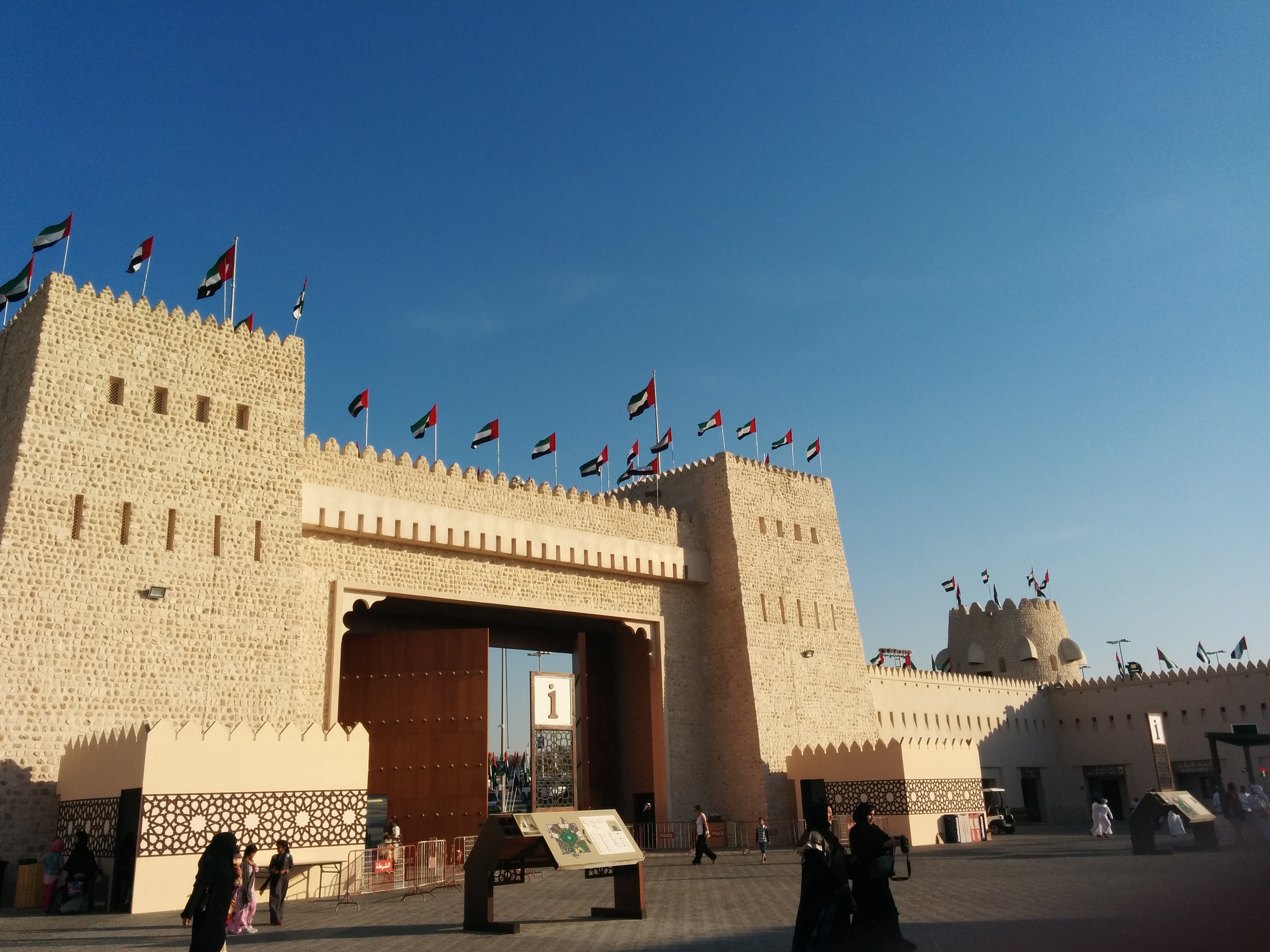
On New Years Day we planned a relaxing day and decided to catch the last day (or so we thought) of the Sheik Zayed Heritage Festival in the Al Wathba Endurance Village. It is located nearby the camel race track and can be reached by car or with a free shuttle bus from Abu Dhabi’s central bus station in Al Wahda which leaves every hour on the hour. In the meantime we have learned that the festival has been extended until January 21st which gives us and everyone an opportunity to visit (again).

img_20170101_161453
Entrance to the endurance village

Since we arrived relatively early, shortly after the festival started for the day, some areas were still being set up. We walked by one of the heritage craft areas where spinning, weaving and working with palm leaves just started to begin. So, our first visit was to the UAE stores which were lined up in tents and small stalls close by. We found clothing, coffee, baked goods,sweets, dates, camel yarn and locally made spindles to be used for spinning the fibres of the region.

The camel yarn felt fairly rough and scratchy and is usually woven into mats or tent fabric. When woven tightly it yields a sturdy fabric which not only provides shade from the sun but shelter from the wind as well. Very useful when living in the open desert or close to the coast where the wind can blow steadily on many days. The spindles are a basic wooden top-whorl design and  are being used as supported and a drop spindle. The wares were lovingly displayed in hand-woven palm leave baskets which I start to really like and might explore purchasing if I can ascertain that they were woven locally and not outsourced to another country. The next area we were drawn to was a heritage exhibit showcasing the traditional Bedouin Ayala dance (that is closest description I could find) and nearby a weaving of palm fronds for mats and of the twisting of palm fiber for the ropes binding the fronds together. Both were works performed by men. I have seen the mats used inside traditional mud and stone houses as floor covers and outside as roofs and walls for a more temporary shelter.

There were many more areas to visit: many Middle Eastern, African and Asian countries were represented with small shops selling their local crafts, arts and foods. A stage close by allowed for occasional traditional dances of the represented region. We saw the military marching band walk by, but missed the Arabian horse show and the fireworks later in the evening.

My most memorable activity was a meeting with a lady who spun her own yarn from her own sheep’s fleece. She invited me to sit in her area and take pictures of her craft. I showed her my mini spindle I had been using to spin some lace-weight Cheviot and she was curious, but found it not practical for her fibre. At one point two young photographers came by to take photos of her spinning and I asked for some translation: The spinner asked me what I used my yarn for (knitting and garments) and I asked where I could find some local sheep wool to buy. Unfortunately, those were her sheep’s fleeces and not for sale. She was very kind to gift me two small amounts of her natural white and dyed orange fibre which I spun up the same evening with my mini turtle-made spindle. I was so excited about my first spinning with local fibre – particularly after reading an article in the Winter 2017 Spin Off magazine about spinning and designing into the fibre shed.

After spinning the white fibre without any preparation from the lock I realized that it was difficult to draft and needed a high twist to hold together. At the same time lots of fibre ends were sticking out making the final “yarn” even more scratchy. So, the orange fibre I prepped by carding it into small rolags from which I spun a more woolen yarn. Overall the orange yarn looked more organized with fewer ends sticking out, but still felt scratchy, albeit a little less.

I decided to try for a two-ply to yield a more balanced yarn and ended up with approximately 3 meters of the natural and the orange colour. After this spin I understand why the Emirati lady thought spinning for lace is not for her: The resulting yarn feels more like rope and is best used for weaving of mats or table runners. I am still excited that I had a chance to try local fibre in my spinning and will continue to look to buy or barter some to play with it a bit in the future. These mini skeins will most likely be woven into a very small square.

It was an auspicious beginning of 2017!

May you have wonderful experiences this year! Happy crafting and exploring! Thank you, for reading my blog.    Maike


Crazy week(s) of spinning

My plan to post shortly after our return from travels was delayed by a good 14 days thanks to Spinzilla: “a monster of a spin event”. This event is organized by the National Needlearts Association’s (TNNA) Spinning and Weaving Group and a lot of fun. The goal is to keep one week free of all activities to spin the largest amount possible. There are teams with up to 25 members and rogue spinners who compete for a mention as the most prolific spinner. Seeing the winner in the rogue category spinning more than 20,000 yards in one week I am amazed and now know that it was a good idea to spin rogue  (by myself) for my first try. I had planned to join TeamGeorgia in Vancouver remotely, but may have not been such a good support with my 2,935 yards in one week. I seriously want to work on my speed. Some pointers like select and prepare all your fiber before the spinning week starts and decline any activities for 7 days I took lightly. Not touching my email (besides one or two important ones) or any housework worked really well, but there is a limit on how much I will neglect time spent with my husband and exploring Abu Dhabi. I planned for that by having one spindle-spun project to work on in the car or while waiting, but deciding on my Turkish lace spindle made for slower progress than working with a larger one. I think that theory will be tested for next year.

Let me guide you through my process. The basic plan was to reduce my stash and have an idea (before spinning) what to make out of the yarn. I had just returned from an amazing two days at my friend’s house in Germany and saw her gorgeous three-ply yarn built out of hues of yellow with  white and a green. Seeing those different fibers and colours of the singles combined to create a beautifully interesting looking yarn made me want to be a bit more relaxed and adventurous about my yarn and allow my intuition and creativity to go beyond my usual “planned” colours. Plus, I realized that with a lot of spinning I might be able to end up with enough for a sweater. That would be a first for me, too!

Since my three braids of roving from Kinfolk Yarn and Fibre added up to about 340 gm of fiber and a sweater would most likely need at least around 400 – 450 gm I decided to add 30 gm of light blue Falkland fiber and 50 gm of a white-blue indigo dyed Corriedale fiber by Kristan MacIntyre. This decision happened on the evening before Spinzilla started and there was no time to blend the fibres by carding. So I thought “Why not try combination drafting?” Rachel Smith described it in her blog Welfordpurls and it did not sound too difficult. Knowing that I was ignoring the fact that drafting of two different fibres will not go smoothly or as consistently as a properly carded blend.

My finished yarn was to be a 3-ply created by plying together my three different colours of combination drafted singles. Before spinning I split all three rovings into half and then halfed them again to spin a quarter of the original onto a bobbin of my Victoria Louet travel wheel. Each of the three single bobbins held about 50-60% of its capacity making it the perfect amount to be plied onto my Majacraft Suzie Pro bobbin.

Singles were S-spun and Z-plied. I set my Louet to 1:8 for the singles and the Suzie to 1:10 for the plying. Resulting in  a slightly overtwisted yarn before finishing it with a hot-cold-hot rinse cycle and a thorough snap before drying. Once dried the yarn was balanced and amazed me with an overall blue-green first impression dotted with interesting highlights of light blue, purple and light green. A small sample turned out to look quite green, but it only showcases about 10 m of the yarn. Other parts have areas where blues dominate.

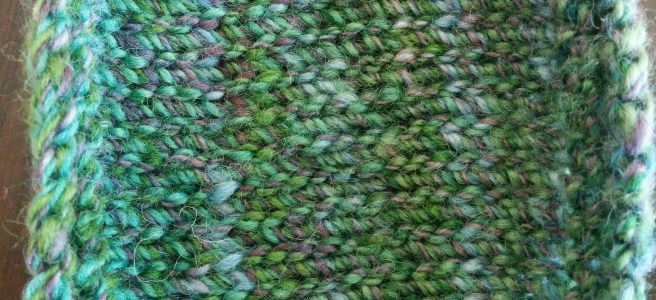
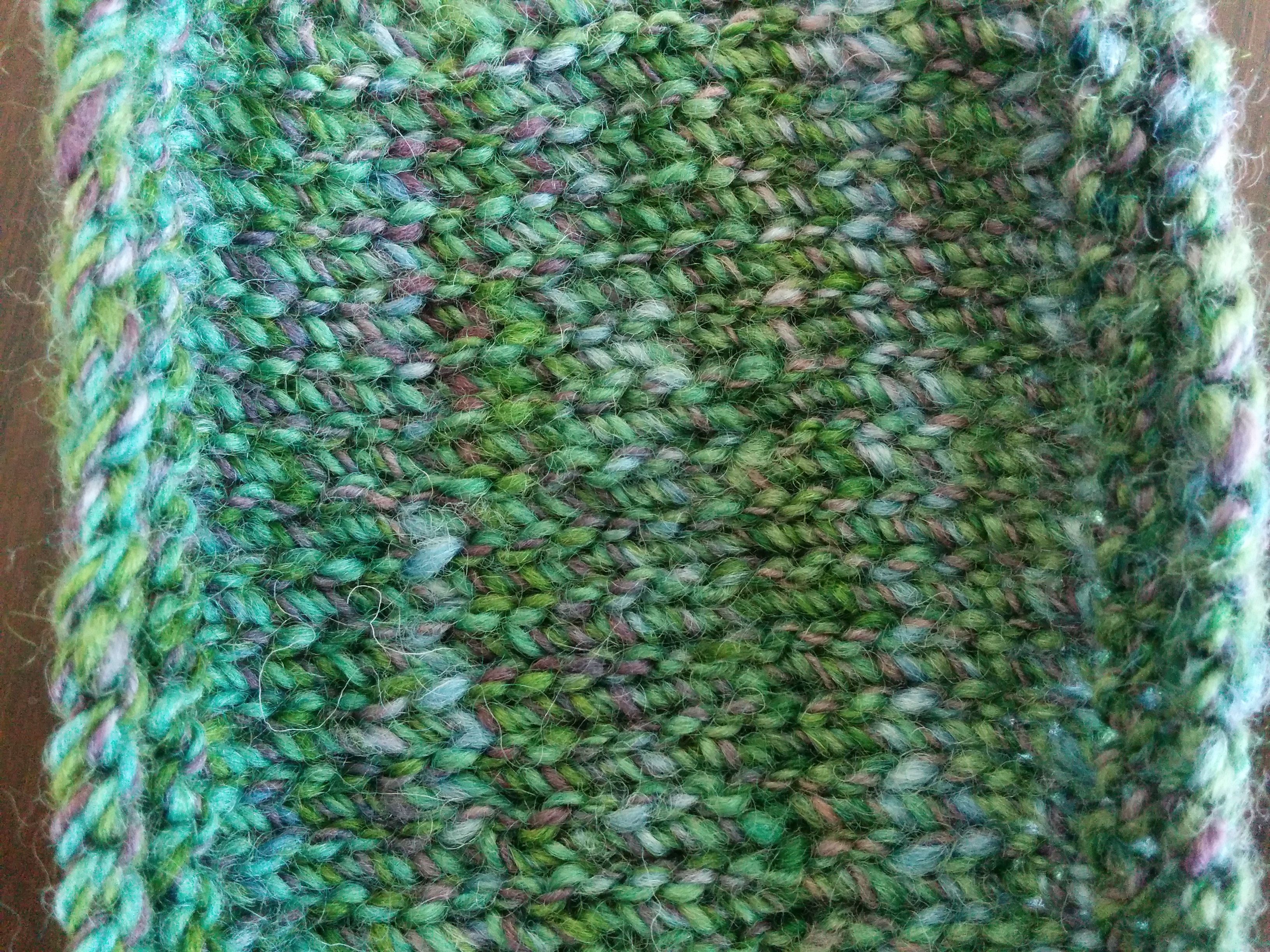
The heathered effect shows well in the knit sample on 3.5 mm needles and yields a dense, but still soft fabric. During Spinzilla 568m in 3 skeins were spun. The fourth skein with 165m was finished in the following weeks resulting in 733m of a DK-weight yarn. Just enough to knit a version of the Garter stitch swingy sweater  by Jenn Pellerin. I will swatch in garter stitch to see if I like the look of my yarn or I may need to either adapt the pattern.

Garter stitch swingy sweater knit by slinkymalinki on Ravelry

In the past two weeks I finished a baby hat (no photo as it was gifted right away), the knit-along scarf and my Stormwatch sweater.

I will try and post a better photo of the sweater in another post. It looks funny with the skinny sleeves on the blocking board but fits well hugging the arms and swings around my body.

Thank you, for reading my blog! Maike


Works in progress: knitting, crocheting and spinning

Since my last post in July, where I was writing about projects in the making, not much has been finished. Some not being in my control, for example : this knit-along shawl. I have finished all I can knit as per emailed out instructions, but will leave it be until the 5th pattern shows up in my mailbox. I am sure it can be a quick finish then.

img_20160906_182846
Four lace patterns done – one more to go
I could “cheat” and just knit the 5th pattern since I test-knit all of them earlier this year, but I feel it is better for me to wait and knit along with everyone else. Especially, when there may be questions popping up. I find it easier to answer while immersed in the process than weeks later.

The shawl I started with the variegated Blue Moon “Socks that rock” yarn combined with a Regia sock wool came along well during my visit in Germany and could have been finished if I had liked the current size. For a while I couldn’t make up my mind if it was big enough and then decided a week ago that with my impending travel back to Munich/Erding next week I have the great chance to buy another ball or two of the Regia sock yarn at Sopie Braun’s Haus der Handarbeit and continue knitting the burgundy edge. At this point it is only about one inch deep and I think the colours look more balanced with at least two inches of the darker colour.

img_20160906_182316

The second knit project I took on the trip is almost done. Really, there is only the last task of adding some eyes and a nose to this cute, little lamb. It probably could pass as a bunny, too, with its droopy ears and small tail. As much as I am happy with the outcome this time again I find that the knitted fabric shows a little the stuffing inside. I noticed this with my baby toy balls as well and thought it might be fixed with a tighter gauge. May be, I need to go down more than 1 mm in needle size?


Once I arrived back in Abu Dhabi the Panda fibre was laid aside and the yak-silk fibre I had sampled during Tour de Fleece was spun. I had decided that to showcast the beautiful colours a long gradient would be best. Which meant that I needed to prepare the fibre. First it was split lengthwise into three strands of roving. Then the first one was seprated after each colour into shorter pieces. The pieces were sorted from fuchsia to blue to purple and spun into a thin single with a ratio of 1:10. The second strand was prepared the same way to yield a lace-weight to fingering weight 2-ply yarn. I was trying for a worsted spin, but the fibre was tending to fly away and didn’t draft consistently after the manipulation. I found it easiest to work with a short backward draft.

Thanks to Wetcoastwools video blog I was bitten by the sweater knitting bug. Glenda and Bernadette have been showing the most amazing sweaters and cardigans they were knitting during the summer and talking about how much they wish it would be fall or winter to be able to wear their new pieces. That was so inspiring that I pulled out a project I had swatched for in 2015 and then put aside to clear some stash before moving. It is the Stormwatch sweater by Holly Yeoh which was started on August 31st with Filisilk yarn (70% Merin, 30% Seide) by Atelier Zitron. I would describe the colour as coral red with a very slight yellow undertone. This yarn is thinner than the recommended sock-yarn in the pattern, but knits up with the same gauge and will be more suitable for our warm  Arabian climate. The oversized fit will allow a lot of airflow which I come to appreciate since moving here.

The very last and most recent craft is a crochet poncho made of 156 flowers. This beautiful, lacy crochet top pattern came to me as a birthday gift and paired with a pretty fuchsia-coloured cotton yarn to get started right away. The pattern called for a few more balls and I found the perfect complementing colours at Greenbranch Trading in downtown Abu Dhabi.

I have to admit that this pattern is way more challenging than I thought. It is a case of reading the instructions, thinking “Oh, this seems easy enough and I am sure I can modify it to not have so much sewing to do” and then being taught by trial and error that it is not. For some reason I was expecting to be able to crochet one flower and continue to the next one without breaking the yarn. With a little bit of thought I could have figured out that it is impossible when crocheting from the middle out. So, there is a thread to be sewn in at the beginning of each flower and at the end. Multiplied by 156 flowers. Yikes! How could I? When I don’t like the non-crocheting part of the work? It turned out to be ok as I am hiding the threads after each flower while working along and thinking of a dear friend that makes it all so much easier. The other learning experience was that I do not as easily understand the written crochet instructions and am heavily relying on the photograph and the chart. In knitting I can work from either one, but not for crochet. I ended up ribbing back and crocheting each of the three rounds three and more times until I was satisfied that I had the result I was expecting. Since my first flower took over an hour to finish I am happy to report that I am down to about 15-20 minutes per flower. A much better speed to finish the final garment before the year is over. I may even be so lucky to use fewer flowers as I find that my first row chain of 10 is quite long already and I like the poncho to cover my shoulders and upper arms, but not down to the wrists. It will be an interesting journey.

Thank you, for reading my blog! Maike