Hello and welcome to my blog! When we moved to the UAE almost a year ago we had made plans not only for new life experiences, different surroundings and climate, but had planned to travel parts of the world which are more difficult to access when the home location is the Westcoast of North America. Living in a hub between Asia, Europe and Africa made this move exciting. The first few months of 2017 were busy with hosting family and friends and showing them around Abu Dhabi. Which has plenty to explore for a week. But now during the hot summer months we have plenty of time to follow our dreams. High on the list had been Oman and the possibility to visit for a weekend. Muscat being only a short 1 hour flight away. A few weeks ago everything fell into place and we booked our flights and one night at the Intercontinental hotel. We received an upgrade to a room that included breakfast, afternoon tea and a Happy Hour.
Seaview Intercontinental hotel Muscat
Teatime snacks
mini scones
Birdnests filled with pistachios
Our room had a great view over the gardens to the sea and we loved the afternoon tea with its mini scones, savoury sandwiches, snacks and little treats to finish. A tea or coffee of your choice was served and it was a fun, family-friendly affair with nice views. All those calories had to be worked off and a walk to the nearby Royal Opera House of Muscat (ROHM) was in order. The adjacent gallery mall just opened in the afternoon when we arrived as it is closed on Friday morning for prayer time.
Dress featuring a print of the Muscat opera house
Royal Opera House Muscat entrance
The stores were very high end and a delight to window-shop. The mall is kept in the same Ottoman (?) style as the opera house and complements its look. While wandering around we saw a most beautiful dress made out of a silk fabric which had a photograph of the opera house printed on it. I was amazed by the colours and the pearl-lace-capelet and would have loved to own it. But it was piece of art created for the gallery only. The ROHM impressed with its outside and inside architecture and surrounding park setting. They were showing the ballet Giselle that evening and we tried to obtain tickets. Unfortunately, it was sold out. We would have loved to see the auditorium space and will wait for a future visit. When the Opera House is not being used for a show one can book a guided tour here.
180-view of ROHM
The next day saw us visiting the Souk in the port area. A busy place with narrow walkways and hundreds of little shops selling everything from clothes, to household items to food and antiques. We strolled through it and tried to avoid the large numbers of cruise ship tourists who visited as well. I was intrigued by the atmosphere, the size of the market and many gracious architectural decors. The carved and metal embossed wooden doors and window coverings are inspiring and I think they would make great knit patterns!
Muscat port and souk
A beautiful entrance
Rare view: shopper-free souk
After a few hours walking around it was time to say Good-bye to Muscat and head back to the airport for our flight home. Muscat left us feeling as if we dipped our toes into an old culture with many more facets to explore.
The beginning of the quiet summer months ahead with fewer art events makes the current opportunities even more exciting. At Manarat al Saadiyat the Guggenheim is presenting a show of some of the pieces which will be housed in the museum once the Frank Gehry & associates designed building will be finished. “The creative act: Performance – Process – Presence” is a fitting title for the show. I had the pleasure of a guided tour and found it enlightening. The different rooms started with some of the first performance artists in Japan and Europe, moving to performance artists in the UAE and more recent art works relating to the Middle East. Some of them exploring videos and emotions about the current Syrian refugee crisis.
Graphic detail on the wall going into “The breathing House” exhibit
Beautiful open mesh and lace crochet…
..creating walls for a breathing house
“The Breathing House” was of particular interest to me as it incorporated crochet in an installation combined with visual and audio effects: the noise of a wind blowing while walking through.
A mountain of sneakers and flipflops
Anish Kapoor’s “Homeland”
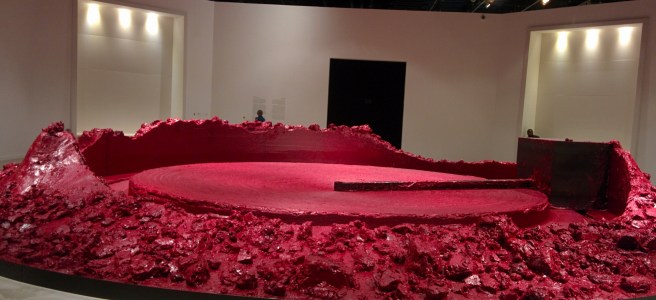
The mountain of discarded sneakers and flipflops by local, Dubai artist Hassan Sharif made the point of a one-way-and-discard society quite clear. But the one which stirred me the most was the large piece “Homeland” by Anish Kapoor. It was less the size or moving hammer changing the piece over time which evoked emotions, but the visceral, oxblood colour and texture of the wax which reminded me of blood, meat and death. A piece that definitely left me uneasy and I am not sure if those associations and feelings are what I wanted to connect with the word “Homeland”. I am sure it has a different meaning for each visitor and by doing so is considered to be true performance art. If you are visiting or live in town: the exhibit is open until July 29th at Manarat Al Saadiyat, daily 9 am – 8 pm. Free entrance, too!
At the same time the Art Gallery at NYUAD is hosting the “But we cannot see them” exhibit of the first performance artists of the UAE. It intersects with the Guggenheim show by displaying different pieces of two artists who were part of the Guggenheim at Manarat exhibit, in addition to younger, local artists influenced by the first generation. It is a great show to visit in conjunction with the Guggenheim and makes it relevant for the local arts community.
Mohamed Ahmed Ibrahim “Lines”
cCose up of “Lines”
The part I enjoyed most was watching a video at the entrance where one artist was describing his artistic life throughout the years. Some funny stories to be heard. One can visit free of charge Monday to Saturday (closed Sundays) at the NYUAD art gallery : 12pm – 8pm until May 27th, 2017.
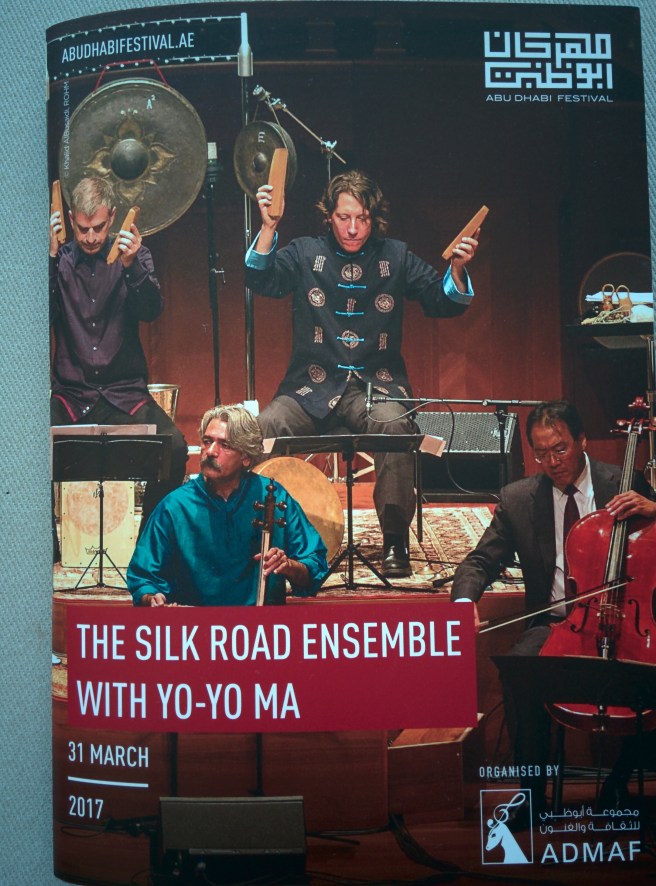
For a more traditional event we had the chance to see Yo-Yo Ma in concert with the Silk Road Ensemble on March 31st. We had listened to his classical concerts on radio and tv and were surprised by this eclectic mix of classic, modern and traditional pieces. A wonderful evening with great acoustics in the auditorium of the Emirates Palace Hotel.
Come visit and experience Abu Dhabi art and culture from September to April! There is a lot to explore…. Until next time! Maike
It has been a few weeks since I last posted a more in depth review of my current knit, crochet and spin projects. I felt there was not much to be reported despite working every day at least for half an hour on one of them. For that reason a pair of socks were chosen to have at least one finished object for March. The test knit cardigan Abu Dhabi Soft by Meiju was my February finished work. It is now published and the pattern can be purchased here.
Abu Dhabi Soft in stripes
It fits nicely!
ankle socks
My slow progress was partially due to hosting guests for about four weeks over three months, partially because I took classes throughout the month of March. My motivation to craft is highest when I have few distractions and can spend longer patches of time on knitting. It seems to increase my productivity…
Some of my works in Progress (or WIPs) are old acquaintances: The crochet poncho grows by about 5 flowers each week when I go to the local Wednesday crochet group. At that speed it will take me another 20 weeks or more to finish it. So, you will be able to watch the growth in very slow motion. The other “seemingly endless” WIP is my pinwheel blanket. 10 squares have been finished and in the current colourway I have enough yarn for another 2 squares. Once the last two squares will be knit I want to decide if a. to stop and leave it at lap blanket size (about 100 x 120 cm), b. knit more squares in another colourway to add or c. Buy some white yarn and knit a border around each square and then knit them all together into a blanket of about 160 x 170 cm. I found an example for a mitered-square blanket with borders here.
Third colour about to start..
ten square make a blanket for a short, skinny adult
Even though this should be plenty to keep me entertained, I crave knitting with my hand-spun 3-ply in sweater quantity I finished spinning in 2016 and had wound into cakes “ready-to-go” in January. While I was knitting on the Abu Dhabi Soft cardigan and mentioning in my blog a little while ago that I was trying to remember a Elizabeth Zimmerman pattern for my hand-spun yarn a dear friend of mine found the pattern and sent a copy. There was no time to be wasted and it was started around March 19th. I am really happy about the progress as it grows rather quickly on the 4.5 mm needles. My latest Project is a hat for charity to reduce some leftover yarn. Additionally, it gave me the opportunity to try one of Barbara Walker’s mosaic patterns from her book “Charted knitting designs”- Four armed square with arms bent eight times. I am enamored by the intricate look, especially in garter stitch and the easy knitting.
DK weight all ready to knit
40 cm to the sleeve increase
mosaic pattern hat
Spinning has been taking a fair amount of my time as well. In January – before I agreed to the test knit – I signed up for the “spin the bin” challenge in the Completely Arbitrary and Twisted (CTA) spinning group on Ravelry. I learned about this challenge from Rachel at Welford purls. One declares at the beginning of the year which braids and fibres one wants to spin, a minimum of 24 ounces = 720 gm. That does not sound like much to some spinners, but it will take me about three and a half months to spin my first 12 ounces of 28 declared. It is basically a challenge to use as much fibre out of my stash as I can to free up some space. This created the goal to knit more from my hand-spun yarn this year and reduce buying yarn to a minimum. Easy, as long as I stay out of yarn stores while travelling..:)
My spin the bin 28 ounces
The first four colours
resulting in this marbled ombre 3-ply sockyarn
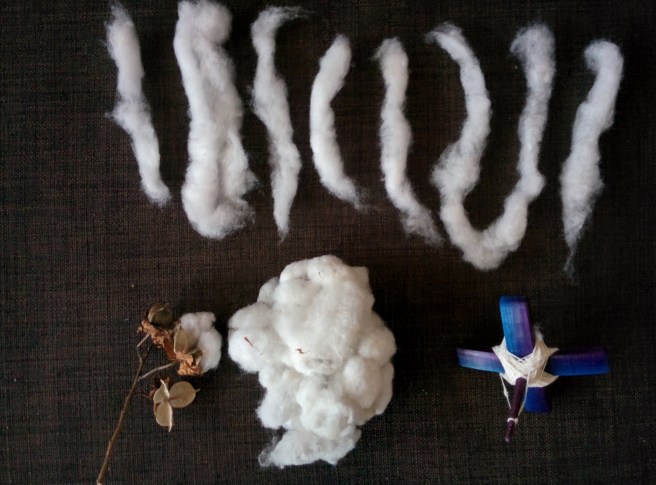
When I read the winter issue of Spin-off magazine in December and January I found an article ” A sweater from my backyard” about sourcing local fibre and working with dye colours available to us in our surroundings. This article had reinforced the idea to find local farmers of sheep or camels here in Abu Dhabi and procure some of their fibres. This has been proven utterly difficult since access to agriculture seems to be for the local people only. Lacking Arabic has not helped neither, as the few crafts people I meet at fairs are often elderly and were educated before English was taught at school. But without looking two opportunities of unexpected fibre have entered my sphere of spinning. The first one is cotton: one of my friends noticed an ugly tree/shrub in her garden and asked the gardener to remove it when he chided her for wanting to kill a valuable tree. With not much watering the tree started to grow cotton flowers that could be harvested. Now, I am in the possession of 15 gm of natural white (and organic) cotton fibre, hand-picked and cleaned from the seeds that I am spinning with my turtle lace-spindle into thin singles. I hope to create about 30-50 meters of a three-ply yarn to return to the cotton-owner to create a memento of her time in Abu Dhabi.
The second local fibre too explore will be described in my next crafting blog. Until then – thank you for following my adventures in the Middle East.
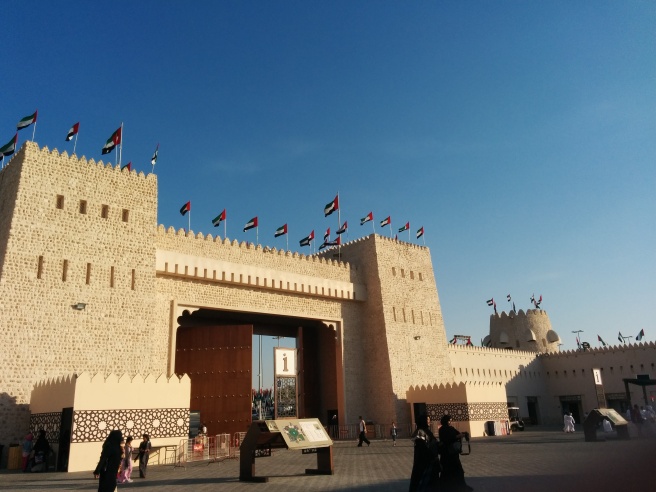
One of the UNESCO World Heritage Sites in the UAE is the Al Ain oasis located in the center of Al Ain adjacent to the Al Ain museum and the Eastern Fort.
West Gate entrance with gift shop and cafe
map of the Al Ain oasis and walkways
On all of our visits we have parked close to the Western Gate area and entered from there. At this entrance you will be welcomed by a guide handing you one of the above maps. It is a very pleasant walk from the Western Gate to the Al Ain museum and the Eastern fort on the opposite site of the oasis. One walks below lush, green date palm trees which provide shade for the visitor and shorter trees e.g. citrus, papaya and bananas.
Walkway through the oasis and wall separating the parcels of land
Under the palm tree canopy
female date palm tree flowers in March 2017
The date palm produces female and male plants with only the female producing the delicious dates which are ready for harvest between July and August. Since palm trees need a fair amount of water to thrive a controlled watering system which allocates just enough at pre-determined times is used in the oasis: the thousands of years old Falaj (or aflaj (pl)). The falaj watering system of this oasis with its canals and gates to guide the water towards the desired area of irrigation has been restored and can be viewed in action while walking around. Each parcel of land separated by a stone wall belongs to one family and the water distribution is decided upon democratically.
Falaj irrigation canal
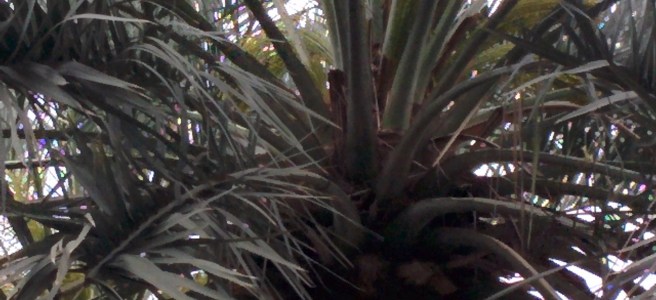
Palm fronds
All parts of the palm tree have been used in the daily life of the oasis inhabitants and in Bedouin life. The green leaf parts can be dried and then woven into mats, bags, bowls and day to day items. The spine or entire frond was used for creating roofs and walls by binding them together with rope made from fibres of the palm trunk. The palm trunk could be used for wooden beams in forts or in thinner sticks to hold up the woven palm walls and roof for a summer house: the Areesh or Barasti.
Al Ain museum
Sultan bin Zayed or Eastern Fort
Door into the Fort
After a stroll through the oasis the Eastern exit leads to the Al Ain museum with its exhibits of archaeological artifacts, traditional culture and gifts given to HH Sheik Zayed bin Sultan al Nahyan. It showcases the daily life of Bedouins before the oil arrived and the skills needed to survive. The oasis and surrounding areas have been inhabited for thousands of years and some artifacts date back to 2,500 BC. All four sites: Al Ain oasis (traditional falaj system), Bida bint Saud (tombs), Jebel Hafit (ancient burial tombs dating back to 5,000 BC) abd Al Hili (Bronze and iron age sites and tombs) – have been named the Al Ain UNESCO Archaeological Sites.
On our way back to the parking lot we like to take a left turn outside of the Western Gate and have a short stroll through the small, botanical garden with its local trees and plants all with name tags for easy identification to reach the Ecological centre.
Eco centre entrance
Description
Interactive screens explain the parts and uses of the date palm tree and the different archaeological sites with their importance in the history of settlement in this area. It has been built with sustainable materials and its roof decorative design resembles the light falling through a palm tree canopy. With air-conditioning this is a pleasant place to explore during anytime of the year.
Before leaving I like to take a look at the gift shop with its handwoven palm-frond handbags, printed coffee mugs and books about the history of the UAE. A snack or meal in the adjacent cafe serving local dishes is highly recommended. One doesn’t want to drive back to the city Abu Dhabi on an empty stomach.
For activities in 2017 check out this website: https://abudhabievents.ae/en/Pages/al-ain-cultural-art-programme.aspx.
Thank you, for reading and providing feedback on my blog. Until next time, Maike
Are you a sock-knitter who knits on the bus, in the car, in line-ups or anywhere when there is a spare moment? Do you carry your knitting with you wherever you go and notice the needles slipping out of the knitting? Then this is the product you want to try and be delighted by the cute designs.
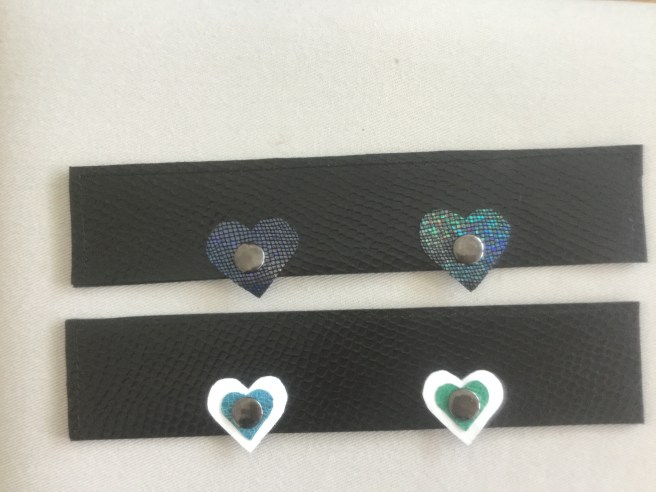
My friend Janka in Australia and owner of ThedaThreads on Etsy has created these fabulous, leather DPN-covers. She started to make coin purses, handbags and shopping bags with playful and fun designs. To help a fellow sock knitter with her needles falling out during transport, poking through my project bags and sometimes pricking my skin – Signature Needle Arts DPNs have stiletto points and are very sharp! – she designed these two cute and practical DPN-needle protectors. They measure 24 cm by 5 cm from edge to edge and fit a set of needles up to 20 cm length.
I was so excited to receive them that I wanted to try their practicality right away. Plus, I had been working on a number of knit, crochet and spin-projects since the beginning of the year that all seem to take a lot of time to finish. So, an easy, fast pair of socks would just fit my need to have finally something to show in less than a month time. My yarn stash is slowly thinning, but a half ball of sock yarn was quickly found and is now on my needles.
knitting needles aligned to be packed
Slide needles and top of knitting into protector
Fasten the press buttons
The DPN protector made of sturdy, but flexible leather not only prevents the needles from sticking out, it helps keeping my knitting organised and the needles in the stitches. Being flat makes for easy packing into project bags and the extra 2 cm of leather can be folded over if a smaller space (e.g. my purse) may require it.
The photos above show how easily the knitting is put away in three little steps or removed when work commences. The fasteners work really well and close tightly. Little hearts add a bit of beauty to the protectors and give me a little, happy jolt every time I see them. The black, structured leather surface reminiscent of snake skin adds to the classy look of my new tools. I love them so much another pair socks will be on the needles as soon as possible.
A few weeks ago a friend of mine from New York City arrived with the Trisha Brown Dance company in Abu Dhabi to present one of their dance installations: “In Plain Site”. A fantastic piece which is presented partly on a stage and partly outside on the roof or balconies of buildings.
phases of the dance
During the time the dance company was in town we had a period of very unusual and unstable weather with alternating sun, wind and rain. The morning I attended the show it rained so much that I had to use the front and back wipers on our car. That meant puddles had formed outside and the dance company adjusted their show to the “rain” alternative, an all-indoors presentation.
The first part was danced in the black box theater and the audience was captivated. Especially, the little ones were intrigued and didn’t want to sit still, but participate. Keeping their parents busy with stopping them from running onto the stage or crying over the music. It was requested that we didn’t take photos inside the black box and all the pictures seen here are of the second part, danced on the floor right outside the theater.
The dancer’s simple clothes and their pared-down, rhythmic movements made it a true delight for the eyes. It looked even better in the black box where the black floor provided a great contrast to the white-clad dancers.
view from the balcony
Another opportunity to explore art arrived with an invitation from one of my groups to visit the Art Hub Abu Dhabi on a guided tour. It is well-known and located in Mussafah, an industrial zone a few minutes of driving outside of Abu Dhabi island. Therefore, it is not as easily found or accessed as many of the other art galleries in town, but the more interesting. The Art Hub is privately owned by Mr Ahmed Al Yafei who created this first artist community in the UAE.
metal camel sculpture welcomes the visitor on the sidewalk
Marhaba! A greeting hand in the UAE flag colours
Artists from different countries of the world are invited to stay at the Art Hub Mussafah and/or Liwa for a few weeks to explore the country and let it inspire them to create from their new experiences. When we visited we just arrived at the end of the Macedonian exhibit with some of the sculptures still on display in the main hall…
.. and the four new artists in residence from Russia starting to prepare for their upcoming show premiere. They were still very busy putting their last finishes to their paintings while we were shown around and had a glimpse of their residence and studio.
Dmitri Sterlkov’s workbench
Anna Nasanova’s “Happy moment”
Ekatarina Abramova’s Diptych “Duality”
We also visited the permanent exhibition of art from previous visiting and local artists, a two-story building with a great variety of styles and materials. Most pieces are for sale and can be found and purchased here.
oil painting of a Bedouin scene on an oil drum lid
Photos applied to a kayak and fixed in place with a clear laquer
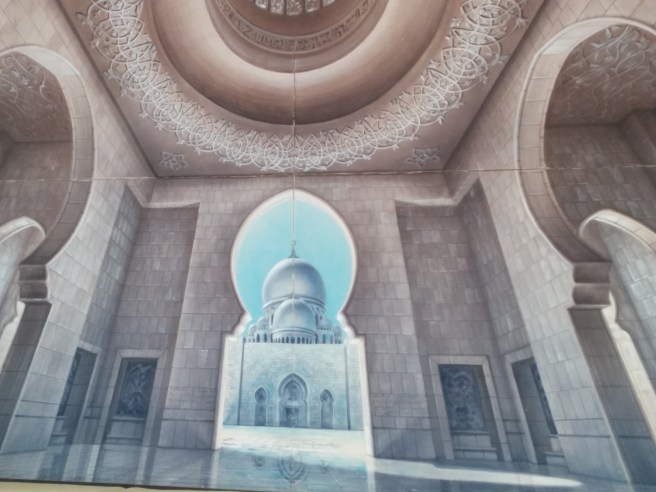
And one wall of the main exhibition for current shows had been painted with an eye-catching image of the Sheik Zayed Grand Mosque giving the illusion that one was looking into the actual mosque.
This city and region continue to amaze and fascinate me. Thank you, for following me along my adventure! Until next time.
If you read my blog a few weeks ago about reviewing some ‘works in progress’ (WIPs) you may have seen the note that the crochet flower poncho had been put into hibernation. But that did not mean that the project had left my mental space. Floating up as a thought once in a while and wondering what to do with it. To understand the wall I was up against I will start with my idea and vision of ‘my’ poncho. It was beautifully displayed on the cover of ‘Love of crochet’ magazine and I fell immediately in love with it. I had four balls of fuchsia pink to crochet with, but needed another 3-4 balls of cotton as per pattern. So, I bought some complimentary colours: a variegated white to fuchsia and a white to create a slow colour change from the bottom edge in white to light fuchsia to fuchsia around my shoulders.
Poncho pattern
Colour gradient
First ten flowers
assembly diagram
Reading through the pattern multiple times there was no mention in which direction the poncho was being crafted or which side of the ‘assembly diagram’ was supposed to the the garment’s bottom or sides. During years of knitting garments and reading their measurement diagrams, those were usually displayed with the bottom edge at the bottom of the diagram. Even when the knit was beginning at one sleeve and knitting across the neck to the other sleeve the diagram would face the same way. Thus, I assumed it to be the same here. I didn’t realize until I had crocheted 10 flowers for my first row, held them stretched out along my shoulder-line from left to right, and wondering if I really needed the other 5, that I may have looked at the assembly diagram the wrong way. Going back to the photo which depicted only short sleeves, I thought my gauge couldn’t be that wrong ( I had measured the first flower and compared it to the given size in the pattern). This was the point when I examined the photo closer, counted the number of flowers in the middle from the bottom edge to the neckline and realizing that the ‘first row’ was being crocheted from the front over the shoulder to the back. Meaning that shown diagram showed me the side edge at the bottom. This was totally screwing up my colour transition plan! Forcing me to create vertical striping instead of horizontal. Not good and a full-stop to my crocheting for the next 3 months.
Thankfully, it all changed when another fellow knitter suggested to join their weekly crochet/craft group. This time I thought “Why not? May be, I will find motivation again to continue the poncho”. One of the nights before the first meeting I woke up in the early morning hours and couldn’t fall asleep again. Suddenly, it hit me: I could just alter the assembly pattern and turn it by 90 degrees on its side.
Working assembly from the bottom edgae up
Colour distribution over 15 rows
second row in progress
Perfect! That would change the look slightly with regards to the borders as now the more wavy border will be falling over my shoulders. Currently, I am working with 10 flowers in one row alternating with 9 in the next and will see how that will impact the setting for the neck opening since there were originally 11 rows = flowers along the bottom edge. As I am plotting along there are ideas popping into my head: how about creating the neck opening in row 8 by leaving out 4 flowers in the middle? That may work. If it looks askew, then I will execute Plan B and add another flower to the end of each row and see if that solves the potential issue…
Anyway, it is so much fun to crochet this project again and seeing it grow every week. I can’t wait to see the colour changing soon!
Thank you, for reading my blog and following my adventures in Abu Dhabi! Maike
Do you like driving and do you like your drive to be a bit more challenging than passing cars on highway? Then this is the road trip to do in the UAE! You will be driving up the highest mountain in the emirate of Abu Dhabi, Jebel Hafeet, measuring 1240 m. Compared to the mountains in British Columbia, Canada, that may not sound that impressive, but it is so much more accessible with a road full of twists, turns and hair-pin curves from the desert floor of Al Ain oasis almost all the way to the top. So much fun to drive! 🙂
Hazy view of Oasis
jagged ridge
Plus, the views in all directions are amazing as the peak is part of a crest of mountains along the border with Oman and is surrounded on all sides by flat terrain. It is one of the few roads in the world which can be driven in any car with its smooth pavement and many viewing points.
A road with twists and turns
Cumbling lime stone
Along the ridge of the mountains
We were amazed to learn that the Mercure chain built a hotel about 3/4 up the way. One has to visit and experience the spectacular views and ample amenities. We chose it as our dinner stop after we had watched the sun set on the horizon. The views from the terrace were fantastic and seeing the city of Al Ain lit up impressed us with its sizable area. We had picked a day with pretty good views, but a nippy wind drove us inside and we enjoyed a delicious dinner of Indian food at Lawrence’s bar before we tackled the two hour drive back to Abu Dhabi.
A big parking lot, cafeteria and fenced viewing area
Al Ain from the terrace at the hotel Mercure
Combined with visiting Al Ain oasis this is a great day trip!
January 2017 already passed and I wondered where the time has gone. Looking at world politics big changes are afoot and worry about humankind’s future are creeping into my mind. I find refuge and happiness in crafting and sharing my excitement about knitting and spinning with anyone who asks. Despite, knitting at least a few rows every day and of late some spinning at my wheel I find I have no finished object to show for all the work. Certainly, it has to do with the size of items I am working on and the preparations to get to the production stage. Plus, living life with family and friends gets me easily distracted. My expectations to have something ready-to-wear or use to show may be heightened by my online following of some fellow craftspeople who I admire for their lively video-blogs and amazing line of finished items to show every week or two. The most prolific and fastest knitter is Mina of the Knittingexpat-Podcast. I love listening to her adventures in sock knitting, designing her own patterns fro scarves, socks, hats and baby garments intertwined with her life journey from the UK to expat life in the Miiddle East and now New York. Not surprisingly one of her published patterns the Pinwheel scrap blanket is one big item I am knitting on.
6 skeins to wind into balls
8 colours: ready!
First pinwheel square
1 month = five squares
It all started with my mental review of knitting, spinning and crocheting of 2016 and thinking of what I really enjoyed. I realized that I wanted to spin more for sweaters or big scarves and feel less “obliged” to work through my store-bought yarns. One result was the decision to unravel a scarf and use the yarns for a different purpose. May be, socks. The other to let my crochet flower poncho hibernate for now. My motivation to continue was already dampened by realizing that the colour distribution I had chosen would not work the way I imagined. Reducing stash works best with a knit or crochet – the latter may have been the wiser decision to reduce my yarns quicker – blanket. It can easily take thousands of meters of fingering weight yarn, but does need patience and endurance to finish. In my excitement to use all garter stitch and being totally motivated I assumed I would have at least 12 squares by now and may be closer to assembling. It being a bit colder in Abu Dhabi these days makes thinking of having a snugly blanket to wrap around me (most apartments have air-conditioning, but no heating unless you count the oven in the kitchen) an exciting thought. Still, with knitting 5 squares I realized that my knitting speed is only half of what Mina manages: 40 instead of 20 minutes for each of the 8 segments to create a square. On top of that there was the winding of 6 x 400 m skeins of yarn into balls/cakes which took me about 5 hours and weaving in 16 ends per square for the 8 colours which takes another half hour or so. At least I can account for about 34 hours of preparation and knitting in January towards a blanket.
The podcaster who most likely moved me from a knitting focused approach into a start with planning, spinning and then using my yarns for an envisioned garment or accessory is Rachel of Wool n’ spinning or Welfordpurls.com. She lives close to Vancouver, our hometown in BC, and is the most inspiring teacher in her videos and blogs. Even though she spins a lot and fast, too, knowing that she has a family and very limited time every day, she still manages to work on knit and crochet projects which feature her hand-spun yarns. Her blog is the “treat” of my week and I try to listen to it with either knitting or spinning at hand and paying close attention. This blog and seeing my friend Uta of Justquilts spin for a sweater quantity of fibre last September lead to this green marbled yarn.
4 Skeins of blue-green hand-spun
DK weight all ready to knit
The skeins had been wound into cakes/balls to knit early in January to be put aside to think some more about a suitable pattern. After my first intention to use the “Garter stitch swingy sweater” pattern by slinkimalinki I was disappointed that the pattern did not print out properly and I would have to sit next to a computer to knit it. Reflecting on previous sweater construction I remembered how I knit Elizabeth Zimmermann’s “Icelandic overblouse” with only 800 m of DK-worsted weight yarn. The pattern uses a double-increase to form a short sleeve while at the same time creating a shoulder seam. Unfortunately, the pattern is part of her book “Knit one, knit all” which I left in storage in Canada.
EZ’s Icelandic overblouse
Now, it was up to my memory to create the increases. A small swatch was made, a mini jacket so to speak, before the call to participate in a test knit for a cardigan came my way and stopped further planning for knitting with my hand-spun.This opportunity was too good to pass and the remainder of my knitting time has been spent on knitting in a fingering weight on 3.5 mm needles. The test knit put me a bit into a tight spot with regards to finding a suitable yarn in my stash. I had bought a sweater’s quantity worth of Holst Coast yarn in November at WetCoastWools – the third video podcast I am following – but the yarn seemed a bit too thin to be knit with a 3.5 mm needle and yield the required gauge. Into the stash I went to find some sock or fingering weight yarn. In the past I picked up many a single skein of sock yarn when traveling and all in different colours. Luckily, my taste trends towards blue, purple and red and after some digging I found three blues that looked about the same thickness and would make a nice striped version of the cardigan.
Holst Coast yarn for future sweater
Three shades of blue for Abu Dhabi Soft testknit
Since the pattern “Abu Dhabi soft” by Meiju Knits is still in the test stage I can’t post any photos of my progress and will do so in a later post. I had hoped that knitting the cardigan would be fast, but with a couple of hundred stitches for each row and almost 200 rows from shoulder to hem it takes a while to knit. Plus, there is the pattern to pay attention to and figuring out if it works when knit as written. Which is the entire purpose of a test knit to see if the written instructions are complete, correct and making sense to any knitter. It has been fun and I hope to be done latest by the end of February as the deadline is early March. To ensure this all will happen as planned I had confined myself to those two projects for the first 28 days and none finished to show for it! This is a bit depressing when I watch the WetCoastwools video podcast with Glenda and Bernadette showing multiple finished items every two weeks. Besides them knitting faster them me, the only other explanation I have, is the fact that they can use bulkier yarns and knit smaller items – who wants to wear a woolen hat in Abu Dhabi?. In any case, it is inspiring to see the yarns and patterns they are discovering and broadens my horizon on what is out there. Without those video, audio (Sweetgeorgiayarns has a great one!) podcasts and blogs I would feel cut off from the creative world out there and back home. It is such a great community!
On New Years Day we planned a relaxing day and decided to catch the last day (or so we thought) of the Sheik Zayed Heritage Festival in the Al Wathba Endurance Village. It is located nearby the camel race track and can be reached by car or with a free shuttle bus from Abu Dhabi’s central bus station in Al Wahda which leaves every hour on the hour. In the meantime we have learned that the festival has been extended until January 21st which gives us and everyone an opportunity to visit (again).
Entrance to the endurance village
Since we arrived relatively early, shortly after the festival started for the day, some areas were still being set up. We walked by one of the heritage craft areas where spinning, weaving and working with palm leaves just started to begin. So, our first visit was to the UAE stores which were lined up in tents and small stalls close by. We found clothing, coffee, baked goods,sweets, dates, camel yarn and locally made spindles to be used for spinning the fibres of the region.
Spindles used by local spinners
camel yarn
The camel yarn felt fairly rough and scratchy and is usually woven into mats or tent fabric. When woven tightly it yields a sturdy fabric which not only provides shade from the sun but shelter from the wind as well. Very useful when living in the open desert or close to the coast where the wind can blow steadily on many days. The spindles are a basic wooden top-whorl design and are being used as supported and a drop spindle. The wares were lovingly displayed in hand-woven palm leave baskets which I start to really like and might explore purchasing if I can ascertain that they were woven locally and not outsourced to another country. The next area we were drawn to was a heritage exhibit showcasing the traditional Bedouin Ayala dance (that is closest description I could find) and nearby a weaving of palm fronds for mats and of the twisting of palm fiber for the ropes binding the fronds together. Both were works performed by men. I have seen the mats used inside traditional mud and stone houses as floor covers and outside as roofs and walls for a more temporary shelter.
twisting of rope from fibres
weaving of mats
Ayala bedouin dance
There were many more areas to visit: many Middle Eastern, African and Asian countries were represented with small shops selling their local crafts, arts and foods. A stage close by allowed for occasional traditional dances of the represented region. We saw the military marching band walk by, but missed the Arabian horse show and the fireworks later in the evening.
Drafting the fibre from a distaff
spinning the yarn
My most memorable activity was a meeting with a lady who spun her own yarn from her own sheep’s fleece. She invited me to sit in her area and take pictures of her craft. I showed her my mini spindle I had been using to spin some lace-weight Cheviot and she was curious, but found it not practical for her fibre. At one point two young photographers came by to take photos of her spinning and I asked for some translation: The spinner asked me what I used my yarn for (knitting and garments) and I asked where I could find some local sheep wool to buy. Unfortunately, those were her sheep’s fleeces and not for sale. She was very kind to gift me two small amounts of her natural white and dyed orange fibre which I spun up the same evening with my mini turtle-made spindle. I was so excited about my first spinning with local fibre – particularly after reading an article in the Winter 2017 Spin Off magazine about spinning and designing into the fibre shed.
fibre from Abu Dhabi sheep
single
playing bracelet
After spinning the white fibre without any preparation from the lock I realized that it was difficult to draft and needed a high twist to hold together. At the same time lots of fibre ends were sticking out making the final “yarn” even more scratchy. So, the orange fibre I prepped by carding it into small rolags from which I spun a more woolen yarn. Overall the orange yarn looked more organized with fewer ends sticking out, but still felt scratchy, albeit a little less.
carding into tiny rolags
single-ply from carded fibre
I decided to try for a two-ply to yield a more balanced yarn and ended up with approximately 3 meters of the natural and the orange colour. After this spin I understand why the Emirati lady thought spinning for lace is not for her: The resulting yarn feels more like rope and is best used for weaving of mats or table runners. I am still excited that I had a chance to try local fibre in my spinning and will continue to look to buy or barter some to play with it a bit in the future. These mini skeins will most likely be woven into a very small square.
two-ply
finished mini skein
It was an auspicious beginning of 2017!
May you have wonderful experiences this year! Happy crafting and exploring! Thank you, for reading my blog. Maike

















 beecosydesign